AI agents are moving beyond simple chatbots.
Instead of only answering questions, modern AI agents can retrieve information, use external tools, interact with business applications, execute workflows, and collaborate with other AI systems.
But this creates an important technical challenge:
How do AI agents communicate with the tools, applications, databases, and other agents they need to complete a task?
This is where AI agent protocols come into the picture.
Protocols provide structured ways for AI systems to discover capabilities, exchange information, invoke tools, delegate tasks, and collaborate across different environments. As businesses move toward agentic AI and multi-agent workflows, interoperability is becoming just as important as the AI model itself.
The importance of this area is also reflected in NIST’s AI Agent Standards Initiative, which focuses on interoperability, open protocols, security, identity, and trusted adoption of AI agents. (NIST)
So, what exactly are MCP, A2A, and ACP? How are they different? And which protocol should businesses consider when building AI-powered applications?
Let’s break it down.
What Are AI Agent Protocols?
AI agent protocols are standards or communication frameworks that define how AI agents interact with external tools, applications, data sources, or other AI agents.
Think of an AI agent as an intelligent digital worker.
The agent might know what needs to be done, but it still needs access to the systems required to complete the task.
For example, imagine a sales AI agent receiving this request:
“Find our customer’s latest order, check whether the product is in stock, and prepare a follow-up email.”
To complete this workflow, the agent may need to:
- Access a CRM
- Query an order database
- Check inventory
- Generate an email
- Potentially ask another AI system for assistance
Without standardized communication mechanisms, every connection could require a separate custom integration.
AI agent protocols aim to make these interactions more consistent and scalable.
The broader industry is moving toward this type of interoperability because AI agents increasingly need to operate across different applications, vendors, frameworks, and data environments. NIST’s current AI Agent Standards Initiative specifically identifies interoperable protocols and agent security as important areas for the emerging agent ecosystem. (NIST)
Why Do AI Agents Need Protocols?
Traditional software applications generally communicate through APIs.
An application sends a structured request, another system processes it, and a response is returned.
AI agents introduce another layer of complexity because they can dynamically decide which tool to use, when to use it, and what information is required next.
For example:
User request → AI reasoning → Tool selection → API call → Result → Further reasoning → Action
As workflows become more complex, businesses need predictable ways to expose tools and capabilities to agents.
The same problem exists when multiple agents need to collaborate.
One agent may specialize in customer support, another in billing, and another in inventory.
Instead of putting every capability into one enormous AI system, organizations can create specialized agents and allow them to communicate.
This is where protocols such as MCP and A2A become especially relevant.
What Is MCP?
MCP stands for Model Context Protocol.
It is an open standard designed to provide a structured way for AI applications to connect with external data sources, tools, and services.
In simple terms:
MCP helps AI applications communicate with tools and resources.
For example, an AI agent could use MCP-based connections to interact with:
- Databases
- APIs
- File systems
- Business applications
- Search systems
- Internal company tools
- Other external services
The official MCP project describes the protocol as a way to integrate AI assistants with external data sources and tools. The protocol has continued evolving, including a major 2026-07-28 specification release focused on areas such as scalability, authorization, extensions, and long-running work. (Model Context Protocol Blog)
Simple MCP Example
Imagine a company has an internal AI assistant.
An employee asks:
“Show me the sales performance of our enterprise customers this quarter.”
The AI model itself may not contain the company’s current sales data.
Instead, the application could use an MCP connection to access the appropriate business data source.
The workflow could look like:
Employee → AI Assistant → MCP → Sales Database → Result → AI Response
The AI does not need to know every internal implementation detail of the database.
It interacts with the available capability through the protocol.
What Is A2A?
A2A stands for Agent2Agent.
While MCP focuses on connecting AI applications or agents with tools and resources, A2A focuses on communication between independent AI agents.
The official A2A documentation describes it as an open standard for communication and collaboration between AI agents built with different frameworks, languages, and vendors. A2A was originally developed by Google and is now part of the Linux Foundation ecosystem. (A2A Protocol)
Consider a customer service platform with multiple specialized agents.
One agent handles customer conversations.
Another specializes in billing.
Another handles order information.
Instead of forcing the customer service agent to perform everything itself, it could delegate a billing-related task to the billing agent.
For example:
Customer Agent → Billing Agent → Billing Result → Customer Agent
The customer may never need to know that multiple agents were involved.
MCP vs A2A: What’s the Difference?
The simplest way to understand the difference is this:
MCP connects agents to tools and resources.
A2A connects agents to other agents.
The official A2A documentation also describes MCP and A2A as complementary rather than competing approaches. MCP addresses tools and resources, while A2A addresses collaboration between independent agents. (A2A Protocol)
| Feature | MCP | A2A |
|---|---|---|
| Main purpose | Connect AI with tools/resources | Connect AI agents with other agents |
| Communication | Agent → Tool/Data | Agent → Agent |
| Example | Agent queries CRM | Sales agent asks research agent |
| Main benefit | Tool interoperability | Agent interoperability |
| Typical use | APIs, databases, services | Multi-agent workflows |
| Focus | Capabilities and resources | Collaboration and delegation |
This distinction is important when designing an AI agent architecture.
A business may actually use both.
What About ACP?
ACP stands for Agent Communication Protocol.
ACP was developed as an open approach for agent-to-agent communication and interoperability.
However, there is an important update businesses should know about.
ACP has now been merged into A2A under the Linux Foundation, and active ACP development is being wound down in favor of contributing its technology and expertise to A2A. IBM Research’s current ACP page explicitly notes this transition. (IBM Research)
So, if you are researching ACP vs A2A, it is important not to treat them as two equally active competing standards in 2026.
For a new project, organizations should evaluate the current A2A ecosystem and migration guidance rather than starting a new implementation around legacy ACP assumptions.
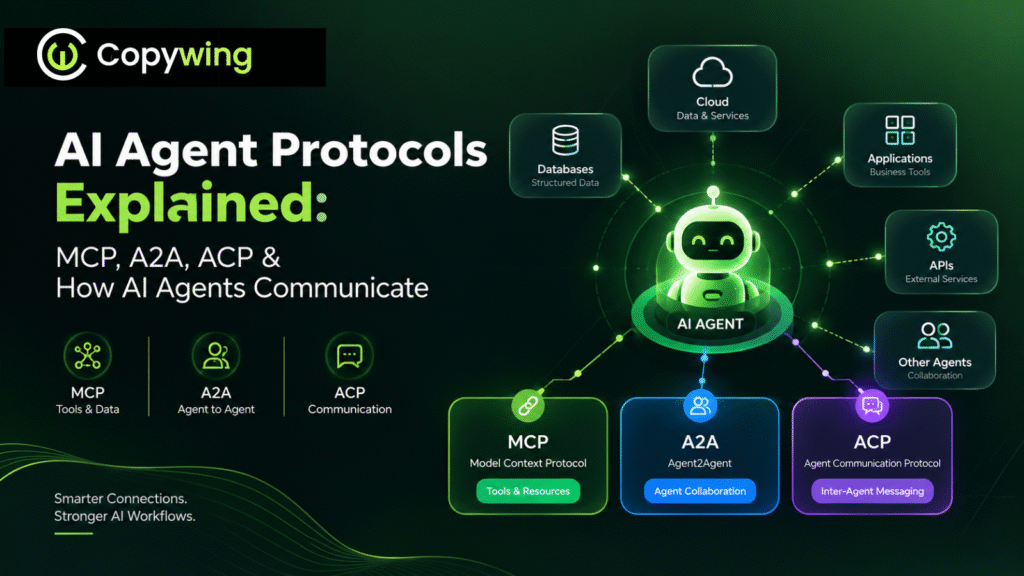
MCP vs A2A vs ACP at a Glance
Here is the simplest comparison:
MCP:
AI agent → tools, APIs, databases, resources
A2A:
AI agent → another AI agent
ACP:
An earlier agent-to-agent communication approach that has transitioned into the A2A ecosystem
The practical architecture can therefore look something like:
User → Main AI Agent → MCP → Business Tools
while simultaneously:
Main AI Agent → A2A → Specialized AI Agent
This creates a connected agent ecosystem rather than a standalone chatbot.
How AI Agent Protocols Work
Although implementations vary, an AI agent workflow can generally be understood through several stages.
1. Understand the Request
The AI agent receives a goal from a user or another system.
For example:
“Prepare a report about our highest-value customers.”
2. Determine What Is Required
The agent identifies the information and capabilities needed to complete the request.
It may need CRM data, sales information, analytics, and customer records.
3. Discover Available Capabilities
The agent determines which tools or agents can provide the required information.
This is where standardized interfaces can become valuable.
4. Invoke a Tool or Agent
The agent sends a structured request through the appropriate protocol.
For example:
Agent → MCP → CRM
or:
Agent → A2A → Analytics Agent
5. Receive the Result
The external system returns information.
The agent evaluates the result and determines what should happen next.
6. Complete the Workflow
The agent generates the final response or takes an authorized action.
This creates a loop:
Understand → Plan → Communicate → Execute → Evaluate → Act
AI Agent Protocols and Multi-Agent Systems
One of the biggest opportunities for AI protocols is the development of multi-agent AI systems.
Instead of one AI agent trying to perform every task, businesses can create specialized agents.
For example, an ecommerce company could have:
Customer Service Agent
Handles customer conversations.
Product Agent
Finds products and answers product-related questions.
Inventory Agent
Checks availability.
Pricing Agent
Handles pricing rules.
Order Agent
Manages order-related workflows.
The customer service agent could coordinate with the others through an agent-to-agent protocol.
This approach can make complex systems more modular.
A similar concept can be used in finance, healthcare, logistics, SaaS, recruitment, customer support, and enterprise operations.
Real-World Use Cases of AI Agent Protocols
AI agent protocols can support a wide range of business applications.
Customer Support
A customer service agent can retrieve account information through connected tools and delegate specialized requests to billing or technical-support agents.
Sales Automation
A sales agent can access CRM information, retrieve account details, research prospects, and coordinate with analytics agents.
Ecommerce
An ecommerce agent can search products, check inventory, calculate delivery options, and coordinate order processing.
IT Operations
An IT agent can retrieve system information, analyze alerts, create tickets, and delegate specialized tasks to security or infrastructure agents.
Software Development
Different agents can work on requirements, coding, testing, documentation, and code review.
Recruitment
An AI recruiting workflow could use separate agents for sourcing, candidate screening, interview coordination, and candidate communication.
This can be particularly useful when companies are moving from simple AI assistants toward broader agentic AI workflows.
Why Businesses Are Interested in AI Agent Protocols
The main advantage is not simply “better AI.”
It is connected AI.
A standalone AI model can generate information.
A connected agent can potentially interact with the systems where business work actually happens.
That creates opportunities to move from:
AI that answers questions
to:
AI that performs workflows
For example:
A traditional chatbot might answer:
“Your order is currently being processed.”
A connected AI agent could potentially:
Check the order → verify inventory → review delivery information → contact the appropriate system → provide an updated response.
The second workflow requires access to external systems.
That is where protocols become valuable.
AI Agent Protocols and Enterprise Integration
Enterprise organizations rarely operate on one application.
A typical company may have:
- CRM
- ERP
- HR software
- Payment systems
- Databases
- Cloud platforms
- Analytics
- Customer portals
- Internal APIs
- Communication tools
Connecting AI to all of these systems individually can create significant development and maintenance work.
A protocol-based architecture can provide a more standardized integration layer.
This becomes especially valuable when developing custom AI solutions that need to work with existing business software.
For businesses looking to build AI-enabled web applications, automation platforms, or custom integrations, CopyWing’s Website Development Services can support custom web platforms, AI-powered applications, integrations, and automation-focused development.
Security Challenges of AI Agent Protocols
Interoperability creates opportunities, but it also creates security risks.
An AI agent with access to multiple systems potentially has more power than a traditional chatbot.
Imagine an agent that can access:
- Customer records
- CRM
- Internal documents
- Financial systems
- Databases
If that agent is compromised or incorrectly configured, the consequences can be significant.
NIST has highlighted that AI agents introduce security challenges involving model outputs interacting with software functionality, including indirect prompt injection, excessive access, and other risks. (NIST)
That means security needs to be designed into the architecture from the beginning.
Identity and Authorization for AI Agents
One of the most important questions is:
Who is the agent?
And more importantly:
What is the agent allowed to do?
An AI agent should not automatically receive unrestricted access simply because it needs one API.
Organizations should define permissions around the agent’s actual responsibilities.
For example:
A customer-support agent might be allowed to:
- Read customer information
- Check order status
- Create support tickets
- Draft responses
But it might not be allowed to:
- Delete customer accounts
- Issue unrestricted refunds
- Modify financial records
- Access unrelated employee information
NIST’s work on AI agent identity and authorization specifically explores how identity, authorization, auditing, and related controls can be applied to software and AI agents. (NIST Computer Security Resource Center)
Human-in-the-Loop for AI Agents
Not every action should be completely autonomous.
Businesses can introduce human approval checkpoints for sensitive operations.
For example:
AI Agent → Prepare refund → Human approval → Execute refund
or:
AI Agent → Draft contract → Legal review → Send
This approach allows companies to benefit from automation while maintaining control over high-impact decisions.
The appropriate level of human involvement depends on the business process, risk level, and regulatory environment.
How to Build an AI Agent Protocol Architecture
A practical architecture can contain several layers.
AI Model Layer
Provides reasoning and language capabilities.
Agent Orchestration Layer
Determines what the agent should do and manages workflow state.
Protocol Layer
Handles communication with tools and other agents.
Integration Layer
Connects CRMs, databases, APIs, cloud services, and business applications.
Security Layer
Manages authentication, authorization, monitoring, auditing, and policy enforcement.
User/Application Layer
Provides the interface through which employees or customers interact with the system.
This layered structure makes it easier to replace individual components without rebuilding the entire AI application.
MCP and A2A Together: A Simple Architecture
A more advanced enterprise system might look like this:
User
↓
Primary AI Agent
↓
Decision / Orchestration
↙︎ ↘︎
MCP A2A
↓ ↓
CRM / Database / APIs Specialized AI Agents
↓
Billing / Analytics / Research
This is where the distinction becomes particularly useful.
MCP can provide access to tools and resources.
A2A can provide communication between agents.
Together, they can form part of a broader agentic architecture. (A2A Protocol)
How Much Does AI Agent Protocol Development Cost?
There is no fixed cost for building an AI agent system.
The price depends heavily on the complexity of the workflow and the number of systems involved.
A relatively simple project may involve:
- One AI model
- A few APIs
- One agent
- Basic authentication
- Limited users
An enterprise system may involve:
- Multiple AI agents
- MCP integrations
- A2A communication
- Multiple databases
- Enterprise APIs
- Cloud infrastructure
- Advanced security
- Monitoring
- Human approval workflows
- Large-scale usage
The biggest cost factors generally include:
AI complexity + integrations + data + security + infrastructure + scale.
Instead of estimating cost from the number of AI features alone, businesses should first map the workflow they want to automate.
AI Agent Protocol Development Process
A structured development process can help reduce unnecessary complexity.
Step 1: Identify the Business Workflow
Start with a real business problem.
For example:
“Customer support employees spend too much time gathering information from multiple systems.”
Step 2: Map Existing Systems
Identify the CRM, databases, APIs, applications, and other tools involved.
Step 3: Decide Where AI Is Needed
Not every step requires AI.
Some tasks can remain traditional software automation.
Step 4: Select the Communication Approach
Determine where a tool-connection protocol such as MCP makes sense and where agent-to-agent communication through A2A may be appropriate.
Step 5: Define Permissions
Determine what each agent can read, write, modify, or execute.
Step 6: Build the Agent Workflow
Develop the orchestration, tools, integrations, and agent communication.
Step 7: Test Failure Scenarios
Test incorrect outputs, unavailable APIs, unexpected data, authorization failures, prompt injection, and other edge cases.
Step 8: Monitor and Improve
Track performance, errors, costs, user feedback, and business outcomes after deployment.
Common Mistakes When Implementing AI Agent Protocols
Building a Multi-Agent System Too Early
Not every problem requires multiple agents.
A single well-designed agent may be enough for a relatively simple workflow.
Giving Agents Too Much Access
An agent should receive only the permissions necessary to perform its responsibilities.
Ignoring Existing APIs
Businesses sometimes try to rebuild functionality that their existing systems already provide through APIs.
Treating Protocols as a Complete Security Solution
A protocol does not automatically make an AI system secure.
Identity, authorization, monitoring, data governance, and application security still matter.
Focusing Only on the AI Model
The model is only one component.
A production AI agent also needs:
Tools + data + integrations + orchestration + security + monitoring.
What Is the Future of AI Agent Protocols?
The AI ecosystem is moving toward more connected and interoperable systems.
NIST’s AI Agent Standards Initiative is explicitly working around standards, open protocols, security, and interoperability because fragmented agent ecosystems can limit adoption. (NIST)
At the same time, MCP continues to evolve, including its 2026 specification work around scalability, authorization, extensions, and enterprise-oriented capabilities. (Model Context Protocol Blog)
A2A is also developing as an interoperability layer for independent AI agents, with the current specification designed around agent discovery, collaboration, task management, and secure information exchange. (A2A Protocol)
This suggests that the future of AI may not be dominated by one giant model doing everything.
Instead, we may see ecosystems where:
Models reason → Agents plan → Protocols connect → Tools execute → Agents collaborate → Humans supervise
For businesses, this could turn AI from an isolated software feature into an operational layer across the organization.
How Businesses Should Approach AI Agent Protocols
Businesses should not adopt MCP, A2A, or any other protocol simply because it is trending.
The better question is:
What business workflow are we trying to improve?
If the requirement is connecting an AI application to databases, APIs, or business tools, a tool-oriented protocol may be useful.
If the requirement is coordinating multiple specialized AI agents, agent-to-agent communication may make more sense.
In more advanced architectures, businesses may use both.
The architecture should follow the business problem—not the other way around.
FAQs About AI Agent Protocols
What are AI agent protocols?
AI agent protocols are communication standards or frameworks that help AI agents interact with tools, data sources, applications, and other AI agents in a structured way.
What is MCP in AI?
MCP, or Model Context Protocol, is an open standard that helps AI applications connect with external tools and resources such as APIs, databases, and services. The MCP ecosystem has continued to evolve through new specifications and enterprise-focused improvements. (Model Context Protocol Blog)
What is A2A in AI?
A2A, or Agent2Agent, is an open protocol designed to enable independent AI agents to discover, communicate, and collaborate with one another across different frameworks and vendors. (A2A Protocol)
Is MCP the same as A2A?
No. MCP and A2A solve different interoperability problems. MCP primarily connects AI applications or agents with tools and resources, while A2A focuses on communication and collaboration between AI agents. They can be used together. (A2A Protocol)
What happened to ACP?
ACP, or Agent Communication Protocol, was an earlier open approach for agent-to-agent communication. ACP has since been merged into A2A under the Linux Foundation, with active development transitioning toward A2A. (IBM Research)
Can MCP and A2A be used together?
Yes. A system can use MCP to connect an agent with tools and data while using A2A to communicate with other specialized agents.
Are AI agent protocols secure by default?
No. Protocols provide communication mechanisms, but organizations still need authentication, authorization, access controls, monitoring, auditing, secure configuration, and other security measures.
How much does AI agent development cost?
AI agent development costs vary based on the number of agents, integrations, AI models, data sources, security requirements, infrastructure, and user scale. A simple AI workflow can be much less complex than an enterprise multi-agent platform.
Do all businesses need AI agent protocols?
No. Simple AI applications may not require complex agent protocols. Protocol-based architectures become more valuable when an AI system needs to work with multiple tools, applications, or independent agents.
Why are AI agent protocols important for businesses?
They can help businesses build AI systems that interact with existing software and collaborate across specialized AI capabilities, making it easier to move from isolated AI assistants toward connected automated workflows.
Conclusion
AI agents are becoming more capable, but their real business value depends heavily on what they can interact with.
An AI model on its own can generate information.
An AI agent connected to business tools can perform workflows.
And multiple connected agents can potentially collaborate on complex tasks.
This is why AI agent protocols are becoming an important part of modern AI architecture.
MCP provides a structured approach for connecting AI applications with tools and resources, while A2A focuses on communication between independent AI agents. ACP is also important to understand historically, but its technology is now transitioning into the A2A ecosystem. (A2A Protocol)
For businesses considering agentic AI, the goal should not be to adopt every new protocol.
The goal should be to build a secure, scalable, interoperable AI architecture around real business workflows.
When AI can understand a goal, access the right tools, communicate with specialized agents, and operate within clearly defined permissions, it becomes much more than a chatbot.
It becomes part of the business infrastructure.