Artificial intelligence is becoming part of everyday business operations, from customer support and sales forecasting to fraud detection, personalized recommendations, and automated workflows. But behind every useful AI application is a less visible requirement: reliable, relevant, and well-organized data.
Many businesses already collect large amounts of information across CRM platforms, ERP systems, websites, databases, cloud applications, spreadsheets, and third-party services. The challenge is that this information often exists in separate systems, uses inconsistent formats, and follows different access rules.
Without a reliable way to connect and prepare these sources, AI applications may work with incomplete information, produce inconsistent results, or fail to reflect actual business conditions.
This is where AI data integration becomes important.
AI data integration connects information from multiple sources, transforms it into usable formats, and makes it available to AI models, analytics platforms, and intelligent applications through controlled, reliable data workflows.
In this guide, we explore what AI data integration means, how it works, the architecture behind it, the technologies businesses use, common challenges, implementation steps, and the costs involved in building an AI-ready data environment.
What Is AI Data Integration?
AI data integration is the process of connecting, consolidating, transforming, and delivering data from different sources so that AI systems can use it effectively.
Traditional data integration often focuses on moving information between applications, synchronizing databases, and supporting reporting. AI data integration includes these activities but also considers the specific requirements of AI workloads, such as contextual relevance, data quality, retrieval, feature preparation, and model-specific input formats.
For example, an e-commerce company may store customer profiles in a CRM, order history in an ERP system, product information in a catalog, and customer feedback in a support platform.
An AI-powered customer service assistant may need information from all four sources to answer a question about a delayed order. AI data integration helps connect these sources so the assistant can retrieve the relevant information without relying on disconnected records.
Depending on the application, the integrated data may be delivered through APIs, data warehouses, data lakes, event streams, retrieval systems, or specialized AI data pipelines.
The objective is not necessarily to combine every business record into one database. It is to make the right information available to the right AI application, in the right format, with appropriate access controls and freshness requirements.
Why Is AI Data Integration Important?
AI applications are only as useful as the information available to them. Even a capable model can provide misleading answers if it receives outdated records, incomplete context, duplicated information, or inconsistent business definitions.
AI data integration helps address these issues by improving the way information is collected, validated, connected, and delivered.
Better AI accuracy and relevance
When AI applications use relevant, high-quality information, they have a stronger foundation for producing useful outputs.
For instance, an AI sales assistant that can retrieve approved product specifications, current pricing, and customer interaction history may provide more relevant recommendations than one relying on disconnected documents or generic model knowledge.
Integration alone does not guarantee accuracy, but it makes reliable context easier to provide.
A more complete view of business operations
Disconnected systems can prevent teams from understanding relationships between customers, transactions, products, and operational performance.
By connecting appropriate data sources, businesses can create a more complete view of their operations. This can support forecasting, customer analytics, operational reporting, and AI-assisted decision-making.
Reduced manual data preparation
Teams often spend significant time exporting spreadsheets, reconciling records, correcting formats, and manually transferring information between applications.
Automated integration pipelines can reduce repetitive work and make data preparation more consistent.
More useful AI automation
AI agents and intelligent workflows often need current business information to perform tasks. A workflow may require customer status, inventory availability, transaction history, or service policies before taking the next step.
A well-designed integration layer makes this information available without giving every AI application unrestricted access to underlying systems.
Improved scalability
As organizations add AI use cases, they need a repeatable way to connect new applications to approved data sources.
A reusable integration architecture can reduce duplicated engineering effort and make it easier to maintain consistent security, validation, and monitoring practices.
Traditional Data Integration vs. AI Data Integration
AI data integration builds on established data engineering practices, but it introduces additional requirements related to AI context, retrieval, and model consumption.
| Area | Traditional data integration | AI data integration |
|---|---|---|
| Primary objective | Move and synchronize data across systems | Make relevant, reliable data usable by AI applications |
| Common destinations | Databases, warehouses, reporting platforms | AI applications, retrieval systems, warehouses, feature stores, and models |
| Data preparation | Schema mapping, transformation, validation | Traditional preparation plus context enrichment and AI-specific processing |
| Data freshness | Scheduled or real-time based on business needs | Depends on the AI use case and the consequences of stale information |
| Quality requirements | Consistency, completeness, and correctness | Those requirements plus relevance, provenance, and suitability for the AI task |
| Security | Access control and data protection | Those controls plus restrictions on retrieval, model context, and AI tool access |
| Monitoring | Pipeline health and data quality | Pipeline health, data quality, and the downstream behavior of AI applications |
The distinction is not absolute. Many successful AI data platforms use the same integration foundations that support analytics and operational systems.
What changes is the way those foundations are designed around AI requirements.
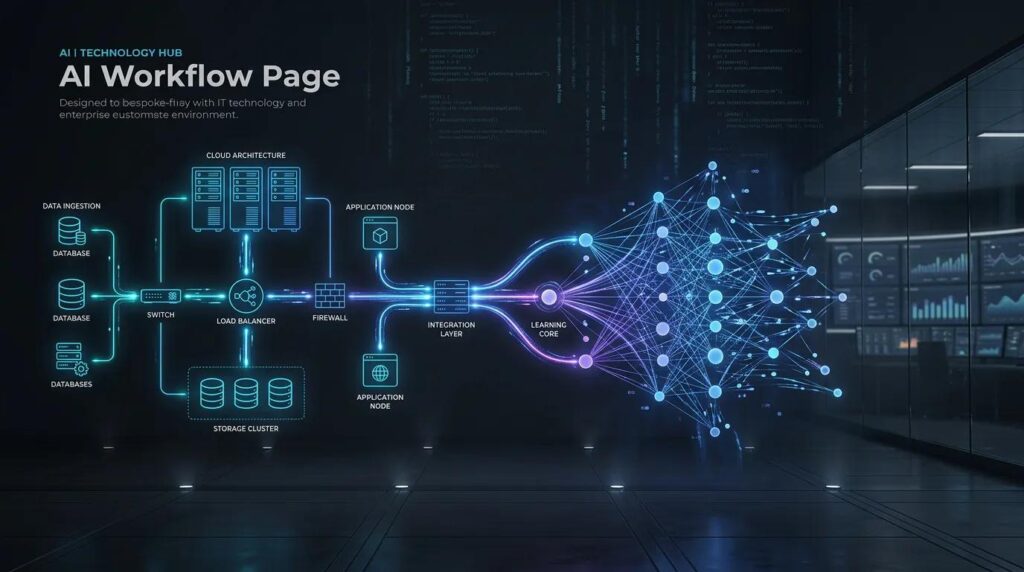
Key Components of an AI Data Integration Architecture
A reliable architecture typically contains several connected layers. Their exact design depends on the data sources, application requirements, security needs, and expected workload.
1. Data Sources
The first layer contains the systems where business information originates.
These may include relational databases, CRM and ERP platforms, customer support systems, cloud storage, business applications, IoT devices, documents, and third-party APIs.
Different sources may expose structured records, semi-structured events, or unstructured content such as PDFs, emails, images, and text documents.
Before integration begins, organizations should identify the data owners, available interfaces, access restrictions, update frequency, and quality limitations of each source.
2. Data Ingestion Layer
The ingestion layer collects information from source systems and moves it into the integration environment.
Depending on the application, ingestion may use scheduled batch jobs, API requests, change data capture, event streams, or file-based transfers.
Batch ingestion can work well for historical reporting and periodic analysis. Event-driven or near-real-time ingestion may be necessary for use cases such as fraud detection, inventory updates, or time-sensitive customer interactions.
The architecture should match the business requirement rather than defaulting to real-time processing for every dataset.
3. Data Transformation and Quality Layer
Raw data often needs to be standardized before AI applications can use it.
This layer may handle schema mapping, data type conversion, duplicate removal, missing-value checks, entity resolution, validation, and normalization.
For example, two systems may identify the same customer using different identifiers or store dates in different formats. Transformation rules help resolve these inconsistencies before the information reaches downstream applications.
Quality checks should detect unexpected changes and reject or quarantine records that fail critical validation rules.
4. Storage and Data Management Layer
Processed information may be stored in a data warehouse, data lake, operational database, document store, or another suitable platform.
Some AI workloads also require specialized components, such as a vector database for semantic retrieval or a feature store for managing features used in machine learning systems.
These technologies serve different purposes. A vector database does not replace every operational database, and a feature store is not necessary for every generative AI application.
Storage decisions should reflect query patterns, data volume, latency requirements, retention rules, and the types of AI workloads being supported.
5. AI Context and Retrieval Layer
AI applications often need selected information rather than an entire dataset.
A retrieval layer can locate relevant documents, records, or knowledge snippets and provide them to the model at runtime. It may use keyword search, semantic search, metadata filters, structured queries, or a combination of these techniques.
For document-heavy applications, retrieval-augmented generation (RAG) is one common approach. It retrieves relevant source material and supplies it as context for a generative AI model.
For operational questions, a direct API call or database query may be more appropriate than semantic retrieval. The architecture should choose the retrieval method that best matches the information being requested.
6. API and Application Integration Layer
The application integration layer makes approved data available to AI assistants, agents, internal tools, and customer-facing applications.
APIs can provide structured information and enforce access rules at the service boundary. Integration services can also manage request validation, authentication, rate limits, and error handling.
When AI agents use tools to retrieve or update information, the integration layer should verify permissions independently of the model’s instructions.
7. Governance and Monitoring Layer
Governance spans the entire architecture. It includes identity and access management, encryption, audit logging, data lineage, retention rules, and monitoring.
Teams should track whether pipelines are operating correctly, whether source data is becoming stale, and whether AI applications are receiving the information they expect.
Monitoring should also help identify failed ingestion jobs, schema changes, unauthorized access attempts, and unusual increases in processing costs.
How AI Data Integration Works
Although implementations vary, most AI data integration workflows follow a similar sequence.
First, the organization identifies relevant data sources and establishes secure connections. Data is then ingested through scheduled jobs, APIs, or event-based mechanisms.
Next, the pipeline validates and transforms the information. Depending on the use case, it may resolve identities, enrich records, split documents into searchable chunks, or attach metadata.
The prepared data is stored or made available through an appropriate service. When an AI application needs information, it retrieves the relevant records and passes only the authorized context into the model or workflow.
Finally, the application returns a response or performs an approved action. Logs, monitoring, and quality checks help the team verify that the overall process is functioning as expected.
Consider an AI assistant for a logistics company. It may retrieve delivery records from an operational database, customer details from a CRM, and delivery policies from a document repository. The assistant uses this information to answer a customer’s question about a shipment.
The integration workflow must ensure that the records refer to the correct customer, the shipment status is current, the policies are approved, and the customer cannot access another person’s information.
This is why AI data integration requires both data engineering and application-level security.
Important Technologies Used in AI Data Integration
The technology stack depends on the organization’s existing systems and the intended AI use cases. Businesses should select tools based on functional requirements rather than adopting every available technology.
APIs and integration platforms
APIs allow applications to exchange structured information through defined interfaces. Integration platforms can help connect enterprise systems, manage transformations, and coordinate workflows.
They are especially useful when AI applications need current operational data or must interact with existing business software.
ETL and ELT pipelines
ETL stands for extract, transform, and load. ELT stands for extract, load, and transform.
These approaches help organizations move data from source systems into a destination where it can be prepared for analytics and AI workloads.
The choice depends on processing requirements, destination capabilities, data volume, and operational constraints.
Streaming and change data capture
Streaming technologies support continuous event processing, while change data capture identifies changes made to source databases.
These approaches can help keep downstream systems updated without repeatedly loading entire datasets. They are valuable when an AI application needs fresh information, although they also introduce operational complexity.
Vector databases and semantic search
Vector databases can store numerical representations of content to support similarity-based retrieval.
They are useful for some RAG applications, document search systems, and knowledge assistants. However, semantic search should often be combined with metadata filters, keyword search, or structured queries to improve relevance and enforce access restrictions.
Cloud data platforms
Cloud data warehouses, data lakes, and managed integration services provide storage and processing capabilities for large datasets.
Their suitability depends on cost, latency, governance, data residency, and integration requirements. A smaller business may not need an extensive cloud data platform for a limited AI use case.
Data quality and observability tools
Data quality tools can validate schemas, detect anomalies, monitor freshness, and identify unexpected changes.
Observability tools help engineers understand pipeline performance, processing failures, and data availability. These capabilities become particularly important when several AI applications depend on shared pipelines.
AI Data Integration Use Cases Across Industries
AI data integration supports different business outcomes depending on the industry and the information being connected.
Healthcare
Healthcare organizations may need to connect clinical records, laboratory results, appointment systems, and patient-generated information. Integrated data can support clinical workflows, operational reporting, and patient-service applications.
Healthcare implementations require careful handling of sensitive information, access permissions, data quality, and applicable privacy obligations. AI outputs should not be treated as clinically reliable simply because the underlying records have been integrated.
Financial services
Banks and financial services companies may integrate transaction histories, customer profiles, account records, and risk-related information to support fraud detection, customer service, and analytics.
Data freshness and accuracy are particularly important when information influences financial decisions. Systems should preserve source provenance and apply appropriate controls to prevent unauthorized disclosure or action.
Retail and e-commerce
Retail businesses can connect product catalogs, inventory systems, order history, customer support records, and marketing platforms.
This may support personalized recommendations, demand forecasting, customer service, and product search.
For example, an AI shopping assistant can provide more useful availability information when its answers are grounded in current inventory records rather than an outdated product feed.
Manufacturing
Manufacturers can combine equipment telemetry, maintenance records, production data, and quality reports to support predictive maintenance and operational analysis.
Integration can help AI systems identify patterns across machines and production processes. The value depends on sensor reliability, consistent identifiers, and the quality of historical records.
Software and technology companies
Software businesses can integrate product analytics, support tickets, documentation, bug reports, and deployment data to help engineering and support teams understand recurring problems.
AI assistants may use this information to summarize incidents, retrieve technical documentation, or support troubleshooting.
Access controls should ensure that customer data, security findings, and confidential development information are available only to authorized users and applications.
Common Challenges in AI Data Integration
AI data integration can improve access to business information, but the work is rarely as simple as connecting a few APIs.
Poor data quality
Duplicate records, missing fields, inconsistent identifiers, and outdated information can reduce the usefulness of AI outputs.
Organizations should define quality rules, identify authoritative sources, and assign responsibility for correcting recurring data problems.
Data silos and legacy systems
Older applications may have limited APIs, undocumented schemas, or tightly coupled databases. Connecting them can require custom integration work or carefully controlled data exports.
A phased approach helps teams prioritize sources that provide the greatest value instead of attempting to integrate every system at once.
Inconsistent data formats
Different systems may represent the same concepts differently. One application may use a customer ID, while another relies on an email address or an internal account number.
Data mapping, canonical schemas, and entity resolution can help establish reliable relationships between records.
Security and privacy risks
Connecting more systems can increase the number of places where sensitive information is processed or exposed.
Organizations should enforce least-privilege access, encrypt data appropriately, control retention, and ensure that AI applications retrieve only information the requesting user or agent is authorized to access.
Data freshness and synchronization
An AI application may return a misleading answer if its information is stale.
Teams should establish freshness requirements for each use case and monitor whether ingestion pipelines meet them. A daily refresh may be adequate for historical reports but unsuitable for live inventory or transaction status.
Cost and operational complexity
Integration costs can increase with data volume, processing frequency, the number of systems involved, and the need for specialized infrastructure.
A simple architecture with a small number of well-chosen integrations is often easier to maintain than an unnecessarily complex platform.
How to Build an AI Data Integration Pipeline
A successful implementation begins with a defined business problem and progresses through data discovery, architecture design, controlled integration, and ongoing monitoring.
Step 1: Define the business use case
Identify the task the AI application must perform and the information it needs.
For example, an AI support assistant may need access to customer profiles, order status, approved troubleshooting guides, and support policies. Defining this scope helps prevent unnecessary data collection and reduces integration complexity.
Step 2: Identify and assess data sources
Inventory the systems that contain the required information. Document their interfaces, owners, data formats, update frequency, quality issues, and access restrictions.
Determine which source should be considered authoritative when records conflict.
Step 3: Design the integration architecture
Choose the appropriate ingestion, transformation, storage, retrieval, and application integration methods.
Consider whether the workload needs batch processing, near-real-time updates, direct API access, a data warehouse, or semantic retrieval. Avoid adding components that do not serve a clear requirement.
Step 4: Clean and standardize the data
Create validation and transformation rules for formats, identifiers, duplicate records, missing values, and inconsistent terminology.
For document-based AI applications, also establish how documents will be parsed, chunked, indexed, and updated. Preserve useful metadata so retrieved content can be traced back to its source.
Step 5: Implement secure data access
Establish authentication, authorization, encryption, and audit logging. Apply data minimization so the AI application receives only the information necessary for its task.
If the application uses retrieval-augmented generation, ensure that document-level permissions are enforced during retrieval rather than only after content reaches the model.
Step 6: Connect the AI application
Integrate the prepared data with the selected AI model, application, or agent workflow.
Define how the application retrieves information, handles missing records, responds to conflicting sources, and behaves when an integration service is unavailable.
Where the application can modify business records, enforce authorization and validation at the tool or service layer.
Step 7: Test data and application behavior
Test the pipeline using representative records and realistic edge cases. Validate accuracy, completeness, freshness, response time, and failure handling.
Also test for unauthorized access, incorrect identity matching, stale information, and retrieval of content that should not be available to a particular user.
Step 8: Deploy, monitor, and improve
Deploy the integration in stages and monitor pipeline health, processing costs, data quality, and downstream AI behavior.
Establish alerts for failed jobs, unexpected schema changes, stale data, and access-control failures. Review performance regularly and adjust the architecture as usage grows.
Businesses planning custom AI applications or connecting AI capabilities with existing digital platforms can explore CopyWing’s website development services for information about its development and AI integration capabilities.
AI Data Integration Best Practices
Strong implementation practices help ensure that an integration pipeline remains useful as business systems and AI applications evolve.
Start with the minimum required data. Integrate only the sources necessary for the intended use case. This reduces cost, simplifies access management, and limits unnecessary exposure of sensitive information.
Preserve data lineage. Maintain enough metadata to identify where information originated, when it was updated, and how it was transformed. Source traceability helps teams investigate incorrect outputs and resolve data disputes.
Define quality checks early. Validate important fields, identifiers, schemas, and relationships before data reaches the AI application. Monitor quality over time rather than relying on a one-time cleanup.
Choose the right freshness model. Match the update frequency to the business requirement. Use streaming or change data capture only when the value of fresher information justifies the additional complexity.
Separate retrieval from authorization. Finding relevant information does not mean an AI application is permitted to access it. Enforce permissions at the retrieval or service layer.
Monitor the complete workflow. Track pipeline failures, latency, data quality, retrieval relevance, and downstream errors. A pipeline that runs successfully can still deliver information that is unsuitable for the AI task.
Plan for failure and recovery. Decide what the application should do when a source system becomes unavailable, a record fails validation, or data becomes stale. Do not let an integration failure silently produce a misleading answer.
Build governance into the architecture. The NIST AI Risk Management Framework provides guidance for identifying and managing AI-related risks. Its risk-management approach can help organizations consider trustworthiness, governance, evaluation, and ongoing monitoring as part of their AI implementation.
How Much Does AI Data Integration Cost?
AI data integration costs vary substantially depending on the number of sources, data volume, system complexity, security requirements, and the type of AI application being built.
A limited integration between a few well-documented APIs may require much less effort than an enterprise platform that connects dozens of legacy systems, processes continuous event streams, and supports multiple AI applications.
The following are illustrative planning ranges, not vendor quotes or guaranteed market prices. Actual costs should be estimated after assessing the requirements and existing infrastructure.
| Project scope | Illustrative development range |
|---|---|
| Basic integration between a few APIs or data sources | $5,000–$15,000 |
| Mid-sized integration with data cleaning, transformations, and an AI application | $15,000–$50,000 |
| Complex enterprise integration with multiple systems, governance, and advanced pipelines | $50,000–$150,000+ |
These estimates represent possible initial implementation budgets. They may exclude ongoing cloud consumption, third-party licenses, model usage, data storage, support, and major legacy-system remediation.
Factors that influence development cost
Number and complexity of data sources: Each source may require separate authentication, mapping, testing, and error handling.
Data quality: Inconsistent or poorly documented data can require significant cleanup and reconciliation.
Processing requirements: Batch pipelines generally have different operational requirements from low-latency streaming systems.
AI architecture: A straightforward API-connected assistant may need fewer components than a system using document retrieval, embeddings, specialized search, and multi-step agent workflows.
Security and compliance: Sensitive data may require additional access controls, audit capabilities, retention policies, and validation.
Maintenance requirements: Monitoring, schema updates, integration changes, and support create ongoing costs after the initial deployment.
Businesses should estimate the total cost of ownership rather than focusing only on the first development milestone.
How to Measure the Success of AI Data Integration
A successful integration should improve the AI application or business process it supports. The number of connected systems alone is not a meaningful measure of success.
Useful metrics include:
- Data quality: Completeness, consistency, validity, and duplication rates.
- Data freshness: The time between a source update and its availability to the AI application.
- Pipeline reliability: Successful runs, failed jobs, and recovery time.
- Integration latency: The time required to retrieve or process required information.
- Retrieval relevance: Whether the application retrieves information appropriate to the user’s question or task.
- AI task success: Whether the application completes the intended workflow accurately.
- Cost per task: The cost of ingestion, processing, storage, retrieval, and AI usage associated with a successful task.
- Security and access compliance: Whether data is accessed only by authorized users and applications.
These metrics should be linked to business outcomes. For example, a customer support integration may be successful if it reduces manual lookup time and improves response accuracy without increasing privacy incidents or operating costs.
The Future of AI Data Integration
AI data integration is likely to evolve as organizations adopt more AI assistants, retrieval-based applications, and autonomous workflows.
One important direction is the growing demand for context-aware data access. Rather than copying every record into a single destination, applications may increasingly retrieve relevant information from approved sources at the moment it is needed.
Another direction is the integration of structured and unstructured information. Business applications often depend on both database records and documents, policies, contracts, and support conversations. Architectures that combine structured queries with document retrieval can support more useful AI experiences.
Real-time data access will also remain important for applications where current information affects the outcome. However, not every use case needs real-time processing; cost, reliability, and business requirements will continue to shape architecture decisions.
Governance and observability will become increasingly important as AI systems gain access to more enterprise information. Organizations will need to understand which sources an application used, whether the data was current, and whether access policies were enforced.
Ultimately, the strongest AI data integration strategies will focus on making information useful, trustworthy, secure, and maintainable rather than simply making more data available.
Conclusion
AI data integration provides the foundation for connecting business information with AI applications, models, and intelligent workflows. It brings together data ingestion, transformation, quality management, storage, retrieval, application integration, and governance.
For businesses, the goal is not to integrate every system at once. It is to identify the data needed for a valuable use case, connect the relevant sources, establish reliable quality checks, enforce access controls, and measure the results.
A well-designed architecture can help AI applications work with more relevant information, reduce manual data preparation, and support scalable automation. But these outcomes depend on sound data engineering, appropriate security, and continuous monitoring.
As organizations expand their use of AI, data integration should be treated as a core part of AI strategy rather than a last-minute technical task.
Frequently Asked Questions About AI Data Integration
What is AI data integration?
AI data integration connects and prepares information from multiple sources so that AI models and applications can use it. It may involve APIs, data pipelines, transformation, retrieval systems, quality checks, and access controls.
Why is data integration important for AI?
AI applications need relevant and reliable information to produce useful outputs. Data integration helps connect disconnected systems, improve data consistency, provide context, and make approved information available to AI workflows.
What is an AI data pipeline?
An AI data pipeline is a sequence of processes that collects, validates, transforms, and delivers data for an AI application. Depending on the use case, it may also include document processing, indexing, retrieval, and monitoring.
What is the difference between AI data integration and RAG?
AI data integration is the broader process of connecting and preparing data for AI systems. Retrieval-augmented generation is a specific approach in which relevant information is retrieved from an external source and provided to a generative AI model as context.
Which technologies are used for AI data integration?
Common technologies include APIs, ETL and ELT tools, cloud data platforms, streaming systems, change data capture, data quality tools, vector databases, and retrieval systems. The right combination depends on the application’s needs.
How do you prepare data for AI integration?
Preparation may include cleaning duplicates, standardizing formats, resolving identifiers, validating records, managing missing values, and preserving source metadata. Document-based applications may also require parsing, chunking, indexing, and retrieval testing.
Is AI data integration secure?
It can be designed securely using authentication, least-privilege permissions, encryption, data minimization, audit logging, and appropriate retention controls. Security also requires enforcing authorization when AI applications retrieve or act on data.
How much does AI data integration cost?
Costs depend on the number of data sources, system complexity, data quality, processing requirements, and security needs. A small integration may cost thousands of dollars, while complex enterprise implementations can require substantially larger budgets.
Can small businesses use AI data integration?
Yes. Small businesses can start by connecting a few essential systems to a customer support assistant, reporting workflow, or internal knowledge application. A limited, well-defined implementation can provide value without requiring a large enterprise data platform.
What are the biggest challenges in AI data integration?
Common challenges include poor data quality, disconnected legacy systems, inconsistent formats, stale information, privacy risks, complex permissions, and ongoing maintenance costs.
How can businesses measure AI data integration ROI?
Measure changes in manual data preparation, task completion time, AI response quality, data errors, pipeline reliability, and cost per successful task. Compare these outcomes with a baseline and include ongoing operating costs in the calculation.