Artificial intelligence is becoming an increasingly important part of modern healthcare. Hospitals, clinics, healthcare technology companies, pharmaceutical businesses, and medical organizations are exploring AI to improve operational efficiency, analyze large volumes of health data, support clinical workflows, and deliver more personalized digital experiences.
From intelligent patient portals and virtual assistants to medical imaging, predictive analytics, and administrative automation, AI can support healthcare organizations across multiple areas.
However, developing AI for healthcare is different from building a standard business application. Healthcare software needs to consider sensitive patient information, security, regulatory requirements, clinical workflows, data quality, accuracy, and human oversight.
The World Health Organization recognizes that AI has potential applications across diagnosis, clinical care, drug development, disease surveillance, and health-system management. At the same time, it highlights the importance of ethics, safety, privacy, equity, and responsible governance.
This makes the development approach just as important as the AI technology itself.
In this guide, we will explore how AI is being used in healthcare, what it takes to develop an AI healthcare solution, the technologies involved, major development costs, potential ROI, implementation challenges, and how businesses can approach healthcare AI development responsibly.
What Is AI in Healthcare?
AI in healthcare refers to the use of artificial intelligence technologies to support healthcare-related tasks, workflows, analysis, and services.
Depending on the application, healthcare AI may use machine learning, natural language processing, computer vision, generative AI, predictive analytics, or other AI techniques.
A healthcare organization could use AI to analyze medical documents, assist with appointment management, summarize clinical information, identify patterns in healthcare data, answer routine patient questions, or support healthcare professionals with information retrieval.
The important point is that AI does not have to replace healthcare professionals.
In many applications, its role is to reduce repetitive work and help professionals access and interpret information more efficiently.
Why Is AI Becoming Important in Healthcare?
Healthcare organizations generate enormous amounts of information every day.
Patient records, laboratory results, medical images, prescriptions, appointment information, clinical notes, insurance documentation, and other operational data all contribute to a complex digital environment.
Manually processing all this information can be time-consuming.
AI can help healthcare organizations identify patterns, automate repetitive processes, and provide structured insights from large datasets.
There is also increasing demand for convenient digital healthcare experiences. Patients expect online appointment booking, faster communication, digital records, remote services, and accessible support.
AI-powered systems can help organizations address some of these expectations while allowing healthcare professionals to focus on higher-value activities.
Major Use Cases of AI in Healthcare
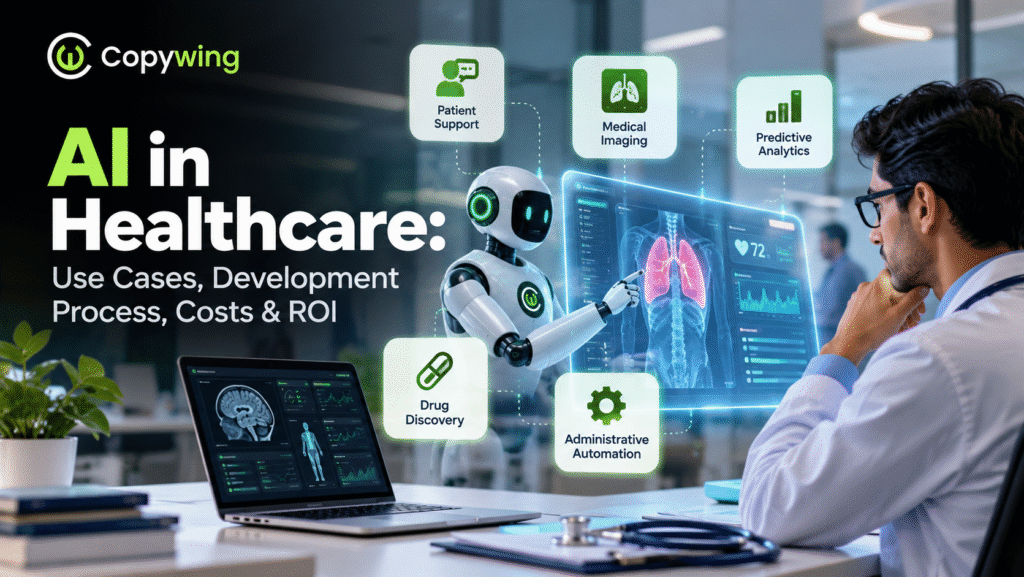
AI can be applied across clinical, administrative, operational, and patient-facing workflows. The World Health Organization highlights applications of AI in areas including diagnosis, clinical care, drug development, disease surveillance, and health-system management, while also emphasizing the importance of ethics, safety, privacy, and equity. WHO’s guidance on AI for health
AI-Powered Patient Support
Healthcare organizations can use AI-powered assistants to handle routine patient interactions.
For example, a virtual assistant can help patients find information about services, understand appointment procedures, locate relevant documents, or navigate a healthcare portal.
These systems can operate outside normal working hours and reduce the volume of repetitive questions handled manually.
However, patient-facing AI should clearly communicate its limitations and provide a route to human assistance when a situation requires professional attention.
Medical Documentation and Summarization
Healthcare professionals often spend significant time working with documentation.
AI can assist with organizing and summarizing information from approved healthcare records.
A properly designed system may help create concise summaries from lengthy documentation, extract relevant information, or organize notes into structured formats.
This can reduce administrative workload while allowing healthcare professionals to review and validate the output.
Medical Imaging Assistance
Computer vision can be used to analyze medical images and identify patterns that may require further examination.
Applications can include areas such as radiology and pathology, where AI models can assist trained professionals with image analysis.
AI should not automatically be treated as a replacement for clinical expertise. Medical professionals need to evaluate AI-generated findings within the appropriate clinical context.
Predictive Analytics
Healthcare organizations can use machine learning models to identify patterns in historical and real-time data.
Depending on the use case, predictive systems can support areas such as:
- Patient risk assessment
- Hospital resource planning
- Readmission analysis
- Demand forecasting
- Appointment no-show prediction
- Operational planning
The quality of these predictions depends heavily on the quality and relevance of the underlying data.
Drug Discovery and Pharmaceutical Research
AI is also being explored in pharmaceutical research and drug development.
Machine learning can help researchers analyze complex biological and chemical datasets, identify potential relationships, and prioritize areas for further investigation.
This does not eliminate the need for laboratory research or clinical validation, but it can help researchers process information more efficiently.
Healthcare Administrative Automation
Not every healthcare AI application needs to be clinical.
Administrative workflows can also benefit from automation.
AI can assist with:
- Appointment scheduling
- Patient communication
- Document classification
- Insurance workflow support
- Data entry
- Internal knowledge retrieval
- Billing-related workflow assistance
These applications can be particularly attractive because they address repetitive processes without directly automating clinical decision-making.
AI in Healthcare: Benefits for Businesses and Healthcare Providers
The business value of healthcare AI depends on the specific workflow being improved.
For some organizations, the biggest benefit may be reduced administrative workload.
For others, it may be improved patient engagement or faster access to information.
Improved Operational Efficiency
AI can automate repetitive tasks that would otherwise require significant manual effort.
This can allow healthcare staff to focus on patient-facing and strategic responsibilities.
Faster Information Processing
AI can process large amounts of structured and unstructured information much faster than manual workflows.
This can help organizations organize data and surface relevant information more efficiently.
Better Patient Experience
AI-powered digital assistants can provide timely responses to routine questions and help patients navigate healthcare services.
Personalized Digital Experiences
AI can support personalized communication and recommendations based on approved patient or user information.
Any personalization involving sensitive health information should be implemented with appropriate privacy and security controls.
Scalable Healthcare Services
AI systems can handle many routine interactions simultaneously, which can help organizations support growing user volumes without increasing manual workload at the same rate.
Healthcare AI Development Process
Developing an AI healthcare solution requires more planning than simply integrating an AI model into an application.
The development process should begin with the healthcare workflow and the problem being solved.
Step 1: Define the Healthcare Problem
The first step is to identify a specific problem.
For example, a healthcare organization may want to reduce the time staff spend answering routine patient questions.
Another organization may need a system for summarizing large amounts of medical documentation.
A clearly defined problem makes it easier to determine whether AI is actually the right solution.
Step 2: Identify the Users
Healthcare software may have several types of users.
These can include patients, doctors, nurses, administrators, technicians, pharmacists, support staff, or business teams.
Each user group may require different permissions and interfaces.
Understanding these roles early helps developers create a more practical system.
Step 3: Assess Data Requirements
AI systems depend on data.
Before development begins, organizations should identify:
- What data is available
- Where it is stored
- Whether the data is structured
- Whether the data is complete
- Who can access it
- How it can legally and securely be used
- Whether additional data is required
Data preparation can become one of the most important stages of healthcare AI development.
Step 4: Select the AI Approach
The technology should be selected based on the use case.
A healthcare application might use machine learning for prediction, computer vision for image analysis, natural language processing for documentation, or generative AI for conversational and summarization workflows.
Not every healthcare problem requires a large language model.
Selecting the simplest technology that reliably solves the problem can make the solution easier to maintain and control.
Step 5: Design the Healthcare Software Architecture
The AI component needs to work within the broader application.
A typical architecture may include the user interface, application layer, AI services, databases, APIs, authentication, analytics, monitoring, and external healthcare integrations.
The system should also be designed so that AI-generated outputs can be reviewed where appropriate.
Step 6: Integrate Healthcare Systems
Healthcare organizations rarely operate using one isolated platform.
An AI application may need to interact with electronic health record systems, patient portals, appointment systems, laboratory platforms, billing software, or internal databases.
Secure API-based integrations can help connect these systems.
For organizations building healthcare-focused digital platforms, CopyWing’s website development services include full-stack development, AI integrations, cloud technologies, and custom web applications.
Step 7: Train, Test, and Validate
AI systems need rigorous testing before they are deployed into real healthcare workflows.
Testing should examine the accuracy and consistency of the system, along with failure cases and unexpected inputs.
Healthcare professionals and relevant stakeholders should be involved when the system’s output could affect clinical or patient-facing workflows.
Step 8: Deploy and Monitor
Deployment is not the end of the project.
AI models and healthcare workflows should be continuously monitored for performance, reliability, security, and unexpected behavior.
As data and workflows change, the system may require updates or retraining.
Technologies Used in Healthcare AI Development
Healthcare AI applications can use several technologies depending on the problem.
Machine Learning
Machine learning can support predictive analytics, classification, pattern recognition, and risk assessment.
Natural Language Processing
NLP can help systems process and understand text such as clinical notes, documents, messages, and other healthcare-related content.
Generative AI
Generative AI can support conversational interfaces, summarization, document assistance, and knowledge retrieval.
Computer Vision
Computer vision can process medical images and other visual information.
Cloud Computing
Cloud infrastructure can provide scalable computing, storage, APIs, monitoring, and deployment environments.
Data Analytics
Healthcare analytics can combine data from different sources to help organizations identify trends and operational patterns.
The right technology stack depends on the intended use case, data requirements, security model, integrations, and scalability needs.
Security and Privacy in Healthcare AI
Security is one of the most important considerations when developing healthcare AI.
Healthcare applications may process highly sensitive information, making unauthorized access or inappropriate data handling particularly serious.
A healthcare AI solution should be designed around appropriate authentication, authorization, encryption, access control, audit logging, and data-management practices.
The system should also limit data access according to user roles.
For example, an administrative employee may not need access to the same information available to a clinician.
Privacy and security should be included in the architecture from the beginning rather than treated as a final development step.
Responsible AI in Healthcare
AI in healthcare creates opportunities, but it also introduces risks that need to be managed.
The WHO emphasizes that AI in health should be developed and used with ethics and human rights at the center. Its guidance identifies concerns including privacy, bias, accountability, transparency, and equitable access.
More recently, WHO published a report in July 2026 addressing ethics review and oversight for AI-related health research, highlighting the need for stronger oversight as AI becomes more deeply integrated into health research.
For developers and healthcare organizations, this means AI systems should have clearly defined responsibilities and limitations.
Human oversight can be especially important when an AI output may influence clinical decisions, patient communication, or other high-impact activities.
Challenges of Developing AI Healthcare Solutions
Healthcare AI development comes with several technical and operational challenges.
One major challenge is data quality. Healthcare data can exist across multiple systems and formats, and incomplete or inconsistent information can affect AI performance.
Another challenge is integration. Healthcare organizations may rely on legacy platforms alongside modern applications, making secure data exchange technically complex.
There is also the challenge of model reliability. AI systems can produce incorrect outputs, which means appropriate validation and human review are important for high-impact applications.
Finally, healthcare organizations need to consider regulatory and ethical requirements throughout the development lifecycle.
These challenges do not mean AI should be avoided. They mean healthcare AI needs a more careful development approach than a conventional consumer application.
How Much Does AI Healthcare Development Cost?
The cost of developing an AI healthcare solution can vary significantly.
A simple AI-powered healthcare chatbot will have very different development requirements from an enterprise platform that integrates patient records, clinical systems, analytics, authentication, AI models, and multiple healthcare APIs.
Several factors influence the overall cost.
The first is solution complexity. More features generally require more development and testing.
The second is AI technology. Different models and AI architectures have different infrastructure and operational requirements.
The third is data. Data preparation, cleaning, annotation, storage, and processing can contribute significantly to development costs.
The fourth is integration. Connecting an application with existing healthcare systems can require substantial API and backend development.
Security, compliance, user roles, analytics, cloud infrastructure, testing, and ongoing maintenance also affect the final investment.
Because of these variables, businesses should define the required functionality and architecture before relying on a fixed development-cost estimate.
ROI of AI in Healthcare
The ROI of healthcare AI should be measured against the specific business problem.
For an administrative AI system, useful metrics might include:
- Reduction in manual processing time
- Cost per administrative task
- Response time
- Staff productivity
- Number of automated interactions
For patient-facing systems, organizations may look at:
- Patient engagement
- Appointment completion
- Response times
- Support volume
- Digital-service adoption
For analytics or operational systems, the organization may measure:
- Forecast accuracy
- Resource utilization
- Processing time
- Operational efficiency
The important point is that AI ROI should not be measured only by how advanced the technology is.
The system should produce a measurable improvement in the underlying healthcare workflow.
When Should a Business Build Custom Healthcare AI Software?
Custom development can make sense when an organization has unique workflows or needs functionality that existing healthcare software does not provide.
A custom solution may be appropriate for healthcare organizations that require specialized patient portals, AI-powered assistants, internal automation, predictive analytics, healthcare dashboards, or integrations with existing systems.
Businesses should also consider whether an existing commercial solution can already solve the problem.
Custom development is most valuable when the organization needs control over the workflow, data architecture, integrations, user experience, or AI capabilities.
Future of AI in Healthcare
Healthcare AI is moving toward increasingly integrated digital ecosystems.
Instead of standalone AI tools, organizations can connect AI capabilities with healthcare applications, patient portals, analytics systems, administrative platforms, and internal workflows.
AI assistants may help patients navigate services, while specialized AI systems assist staff with documentation, information retrieval, scheduling, and operational analysis.
At the same time, healthcare organizations will need stronger governance and oversight as AI becomes more deeply integrated into health services and research.
WHO’s current AI-for-health work emphasizes responsible adoption, governance, safety, equity, and collaboration as healthcare systems expand their use of AI.
The future of healthcare AI will therefore depend not only on better models, but also on better software architecture, data governance, security, validation, and responsible implementation.
How CopyWing Can Help With Healthcare Web Development and AI Solutions
Healthcare businesses need digital platforms that are secure, scalable, easy to use, and capable of supporting their specific workflows.
CopyWing provides full-stack web development services covering responsive web design, custom business websites, web applications, cloud technologies, AI integrations, and automation. Its development offering also includes custom AI solutions, AI-powered chatbots, machine learning integration, and AI-driven analytics.
For a healthcare organization, these capabilities can support the development of patient-facing websites, healthcare portals, AI-powered assistants, dashboards, custom web applications, and workflow automation systems.
If you are planning a healthcare website or AI-powered healthcare application, explore CopyWing’s healthcare web development capabilities to see how a custom digital solution can be built around your organization’s requirements.
Frequently Asked Questions
What is AI in healthcare?
AI in healthcare refers to the use of artificial intelligence technologies to support healthcare services, clinical workflows, administrative processes, data analysis, patient engagement, and other health-related activities.
What are the most common applications of AI in healthcare?
Common applications include patient support, medical documentation, predictive analytics, medical imaging assistance, administrative automation, healthcare analytics, and pharmaceutical research.
How much does healthcare AI development cost?
There is no fixed cost. The investment depends on the application’s complexity, AI model, data requirements, integrations, security, infrastructure, testing, and ongoing maintenance.
How long does it take to develop an AI healthcare application?
The timeline depends on the scope. A relatively simple AI assistant may require considerably less development time than an enterprise healthcare platform involving multiple integrations, custom AI models, complex workflows, and extensive testing.
Is AI safe for healthcare applications?
AI can be used responsibly in healthcare, but safety depends on the specific application, data, validation, security, human oversight, and governance mechanisms. AI systems should not be treated as automatically reliable simply because they use advanced models.
Can AI replace healthcare professionals?
AI can automate and assist with certain tasks, but many healthcare activities require professional judgment, contextual understanding, and human responsibility. AI is generally more useful when it augments healthcare professionals rather than removing appropriate human oversight.
Why is healthcare web development important for AI solutions?
AI capabilities need to operate within a reliable digital platform. Healthcare web development provides the user interface, backend infrastructure, integrations, security controls, and workflows required to deliver AI-powered functionality to patients, clinicians, administrators, or other users.
Conclusion
AI is creating new opportunities for healthcare organizations to improve digital services, automate repetitive processes, analyze complex information, and build more connected healthcare experiences.
However, successful healthcare AI development requires more than choosing an AI model.
Organizations need a clearly defined use case, reliable data, secure infrastructure, appropriate integrations, strong testing, and responsible governance.
The most practical approach is to begin with a specific healthcare problem and determine how AI can improve that workflow. From there, businesses can design a solution that combines AI capabilities with secure web development and appropriate human oversight.
As healthcare continues to become more digital, organizations that approach AI strategically can build solutions that are not only technologically advanced but also useful, scalable, and aligned with real healthcare needs.