Recruitment has changed significantly with the rise of artificial intelligence. Hiring teams are no longer dealing only with resumes and job applications. They are managing large candidate databases, multiple sourcing channels, interview schedules, communication platforms, assessments, and constantly changing skill requirements.
The challenge is not always finding applicants. The bigger challenge is finding the right candidates, reviewing them efficiently, maintaining timely communication, and moving qualified applicants through the hiring process without creating unnecessary delays.
This is where AI recruiting agents are becoming increasingly useful.
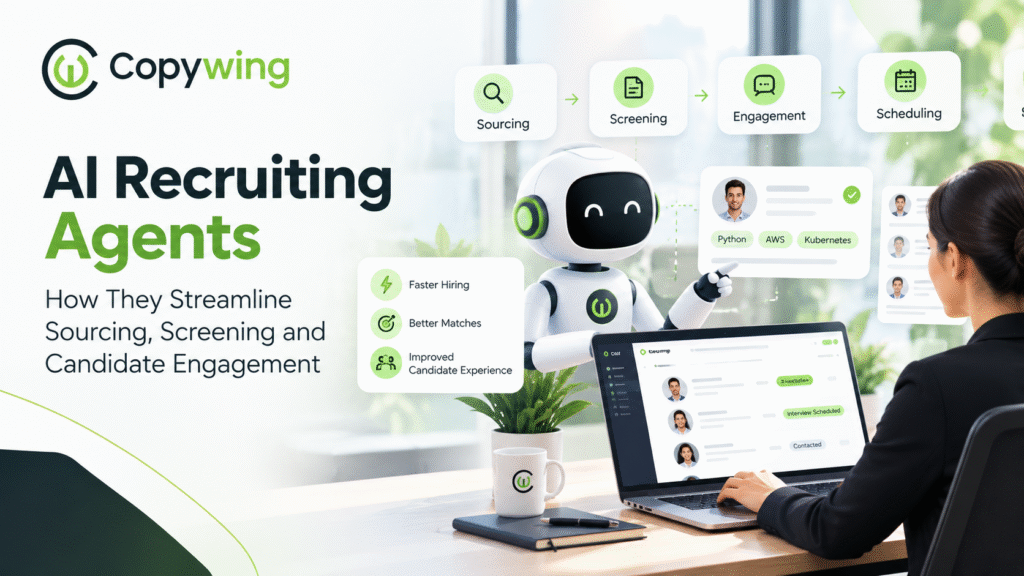
An AI recruiting agent can connect different stages of the recruitment process and perform approved tasks with limited human intervention. Instead of simply helping a recruiter complete one action, an agent can coordinate several related activities, such as searching candidate databases, organizing profiles, assisting with screening, preparing outreach messages, following up with candidates, and scheduling interviews.
The World Economic Forum’s Future of Jobs Report 2025 estimates that 39% of workers’ existing skill sets are expected to change or become outdated between 2025 and 2030. This creates additional pressure on businesses to identify skills efficiently and build recruitment processes that can adapt to changing workforce requirements.
For organizations considering AI-powered recruitment, the important question is not simply whether AI can automate hiring tasks. The real question is how AI agents can fit into an existing recruitment workflow while maintaining human oversight, data security, transparency, and a good candidate experience.
What Is an AI Recruiting Agent?
An AI recruiting agent is an AI-powered software system designed to work toward a defined recruitment objective.
Traditional recruitment automation usually follows predefined rules. For example, when a candidate submits an application, the system may automatically send a confirmation email.
An AI recruiting agent can coordinate a more complex workflow.
A recruiter may give the system an approved hiring requirement for a software developer. The agent can then interpret the requirements, search authorized candidate sources, organize relevant profiles, identify evidence of required skills, prepare a shortlist for review, draft candidate outreach, and coordinate interviews with candidates who respond positively.
The agent does not need to make the final hiring decision.
Instead, it can take care of repetitive operational work while recruiters remain responsible for important decisions and candidate relationships.
This makes AI recruiting agents different from simple recruitment chatbots or individual AI features. A chatbot may answer candidate questions, while a resume-parsing tool may extract skills from a CV. An agent can potentially connect several such capabilities into one workflow.
How AI Recruiting Agents Work
An AI recruiting agent generally operates through several connected layers.
First, it receives a defined objective, such as helping a recruiter create a shortlist for an open position. It then accesses approved recruitment information, including the job description, skills requirements, candidate records, and organizational hiring policies.
The agent can use connected tools such as an applicant tracking system, recruitment CRM, calendar, email platform, or approved candidate database. It processes information, determines the next permitted action, performs that action, and checks the result.
For example, if an agent identifies a candidate who appears to meet the required criteria, it may prepare a recruiter-facing summary rather than automatically rejecting or advancing the candidate.
This distinction is important because recruitment decisions can have significant consequences for candidates.
A well-designed system should therefore have clearly defined permissions. Low-risk activities can be automated, while sensitive decisions should be routed to a human.
AI Recruiting Agents vs Traditional Recruitment Automation
Traditional automation is generally based on fixed triggers and rules.
For example:
Candidate applies → Confirmation email → Candidate moves to application stage
An AI recruiting agent can coordinate a more dynamic workflow:
Job requirement → Candidate search → Profile analysis → Recruiter review → Approved outreach → Candidate response → Interview scheduling → ATS update
The main difference is not that one system uses AI and the other does not. The difference is how the system handles workflow context and multiple connected actions.
An applicant tracking system remains valuable because it acts as the central record for recruitment information. An AI agent can work alongside it rather than replacing it.
This makes an AI recruiting agent more like an intelligent workflow layer connecting existing recruitment tools.
How AI Recruiting Agents Improve Candidate Sourcing
Candidate sourcing can consume a significant amount of recruiter time, particularly when organizations are hiring for several positions simultaneously.
Recruiters may search professional networks, recruitment platforms, internal databases, previous applicants, and talent communities. They then have to compare profiles, remove duplicates, and organize candidates for review.
AI can reduce some of this repetitive work.
An AI recruiting agent can start by converting a job description into structured search criteria. It can distinguish between mandatory skills and preferred experience, identify relevant keywords and related competencies, and search approved candidate sources.
For example, a company looking for a cloud engineer may require experience with AWS, Kubernetes, Python, and infrastructure automation.
Instead of relying only on the exact job title “Cloud Engineer,” an AI system can help identify candidates whose documented experience contains relevant skills even if their current job title is different.
This becomes increasingly important as job roles and required skills continue to evolve.
The World Economic Forum reports that employers expect significant changes in workers’ skill requirements through 2030, with 39% of existing skill sets expected to be transformed or become outdated.
Rediscovering Existing Candidates
One of the most overlooked opportunities is the existing talent database.
Companies may already have thousands of previous applicants stored in their ATS or recruitment CRM. When a new position opens, recruiters often begin sourcing from scratch.
An AI recruiting agent can help search approved historical candidate records and identify profiles that may now be relevant.
This can be especially useful when the organization frequently hires for similar roles.
Instead of treating every recruitment campaign as a completely new search, companies can make better use of their existing talent pool.
How AI Helps With Candidate Screening
Screening is another area where recruitment teams can spend considerable time.
A recruiter may need to review hundreds of resumes to determine which candidates meet the basic requirements of a position.
AI can help organize this information.
Rather than simply producing a score, a well-designed system can show recruiters the evidence behind a candidate’s potential match.
For example:
Required skill: Python
Candidate evidence: Five years of Python development experience listed across previous roles.
Required skill: AWS
Candidate evidence: Experience managing AWS infrastructure and cloud deployments.
Potential gap: No clear evidence of Kubernetes experience.
This approach gives recruiters more context than an unexplained percentage score.
The recruiter can then decide whether the candidate should progress.
Why Explainability Matters
Recruitment AI should not become a black box.
If a system recommends a candidate, recruiters should be able to understand why the profile was surfaced.
Likewise, if a candidate appears not to meet a requirement, the system should distinguish between “requirement not met” and “information not found.”
These are two very different situations.
A candidate may not mention a particular skill on a resume even though they have the experience. AI systems should therefore support human review rather than treating missing information as definitive evidence.
How AI Recruiting Agents Improve Candidate Engagement
Finding a candidate is only one part of recruitment.
Candidate communication can become equally difficult when recruiters manage dozens or hundreds of applicants simultaneously.
Candidates may wait for updates, need answers to routine questions, or need to reschedule interviews.
AI recruiting agents can help automate some of this communication.
Personalized Candidate Outreach
Instead of sending exactly the same message to every candidate, an AI system can prepare personalized drafts based on approved candidate information.
For example, a recruiter contacting a backend developer might reference the candidate’s documented experience with distributed systems if that experience is relevant to the open role.
The system should not invent experience or make unsupported claims.
Recruiters should also be able to review or control outreach rules depending on the organization’s recruitment process.
Automated Follow-Ups
Recruiters often have to remember which candidates need follow-up and when.
An AI agent can monitor the workflow and trigger approved communications.
For example, a candidate who has not responded to an initial message may receive a follow-up after a defined period. If the candidate replies, the conversation can be routed back to a recruiter.
This reduces manual tracking while maintaining a structured communication process.
Candidate Questions
AI recruiting assistants can also answer routine questions related to:
- Application status
- Interview format
- Required documents
- General role information
- Scheduling
- Recruitment process
Questions involving sensitive employment matters should be routed to a human representative.
The goal is not to replace recruiters in every conversation. It is to make sure recruiters do not spend most of their time answering repetitive questions.
AI-Powered Interview Scheduling
Interview scheduling can become surprisingly complicated.
A single interview may involve a candidate, recruiter, hiring manager, technical interviewer, HR representative, and multiple calendars.
An AI scheduling agent can coordinate availability, identify suitable time slots, send scheduling options, confirm appointments, and update the recruitment system.
It can also help with rescheduling when an interviewer becomes unavailable.
This is a relatively practical area for automation because scheduling is largely operational and rule-based, while the actual interview remains a human activity.
AI Recruiting Agents and Recruitment Data
Recruitment systems contain a significant amount of information.
Candidate resumes, interview notes, communication history, skills, application stages, recruiter comments, and hiring outcomes may all exist across different systems.
AI agents can connect these data sources to provide recruiters with a more unified view.
However, greater connectivity also increases the importance of access control.
An agent that can access an ATS does not automatically need access to every field in the ATS.
Permissions should be based on the agent’s role.
For example, a scheduling agent may need access to candidate contact details and interviewer calendars but should not require access to unrelated employee information.
Building an AI Recruiting Agent Architecture
A scalable AI recruiting solution usually consists of several components.
The user interface allows recruiters or candidates to interact with the system. The agent orchestration layer manages tasks and workflow state. AI models provide language understanding, classification, summarization, matching, or other capabilities.
A knowledge layer provides approved recruitment policies, job information, FAQs, and communication guidelines.
An integration layer connects the agent with systems such as ATS platforms, recruitment CRMs, calendars, email services, HRIS platforms, and assessment tools.
Finally, the security and governance layer controls authentication, authorization, audit logs, data retention, and human approval.
This architecture allows the AI agent to operate within the company’s existing technology environment rather than creating another isolated recruitment application.
Human Oversight in AI Recruitment
Recruitment is an area where human oversight remains important.
An AI system can assist with sourcing, screening, communication, and scheduling, but organizations should carefully determine which actions can happen automatically.
For example, sending an interview reminder may be suitable for automation.
A final hiring decision is fundamentally different.
The organization should define where a recruiter or hiring manager must review the AI’s output before an action is taken.
This can be implemented through approval workflows, confidence thresholds, escalation rules, and audit trails.
NIST’s AI Risk Management Framework provides voluntary guidance for organizations that design, develop, deploy, or use AI systems and focuses on incorporating trustworthiness considerations into AI risk management.
Privacy and Security Considerations
Recruitment involves personal information, which makes privacy and security especially important.
Organizations implementing AI recruiting agents should consider how candidate information is collected, stored, accessed, processed, retained, and deleted.
The agent should only receive the information necessary for its assigned task.
For example, a sourcing agent may need professional experience and skills, but it may not need access to unrelated personal information.
Businesses should also maintain appropriate authentication, role-based access, encryption, audit logging, and data-retention controls.
Security should be considered during architecture and development rather than added after deployment.
Common Challenges With AI Recruiting Agents
AI recruiting agents can improve recruitment workflows, but implementation also creates new challenges.
One challenge is data quality. If candidate information is incomplete, outdated, duplicated, or inconsistent, the AI may produce less useful results.
Another challenge is integration complexity. Large organizations often have several HR and recruitment systems that were implemented at different times. Connecting them securely can require significant technical work.
There is also the issue of bias and fairness. Historical hiring data may contain patterns that should not simply be reproduced by an automated system. Organizations should evaluate AI outputs using job-related criteria and establish processes for identifying problematic outcomes.
Finally, there is the risk of over-automation.
An AI system can perform many tasks, but that does not mean every task should be automated.
The strongest recruitment workflows usually combine automation with clear human ownership.
How to Implement an AI Recruiting Agent
Businesses should not begin an AI recruitment project by choosing a model first.
The better starting point is identifying a recruitment problem.
For example, an organization might discover that recruiters spend several hours every week scheduling interviews. That process can be mapped, measured, and evaluated as a potential AI automation opportunity.
After selecting a use case, the organization can define the agent’s responsibilities, prepare the required data, connect relevant systems, establish human approval points, and test the workflow before production deployment.
A controlled rollout also makes it easier to measure whether the system is actually improving recruitment performance.
Metrics to Measure AI Recruiting Performance
AI recruiting agents should be measured using business and recruitment outcomes rather than the number of tasks they automate.
Useful metrics can include time spent sourcing, time to shortlist, candidate response rate, interview scheduling time, application completion, recruiter workload, human override frequency, and candidate drop-off.
For example, if an AI sourcing agent produces more candidate profiles but the recruiter spends even more time reviewing irrelevant profiles, the automation has not necessarily improved the process.
The important question is whether the overall recruitment workflow has become more efficient and useful.
When Should a Business Build a Custom AI Recruiting Agent?
A custom solution may be appropriate when a company has complex recruitment workflows, high hiring volumes, multiple recruitment systems, large internal talent pools, specialized screening requirements, or strict governance needs.
For a small company hiring occasionally, existing recruitment software may already provide sufficient functionality.
For a larger organization, however, a custom agent can be designed around its existing ATS, CRM, HR processes, approval structure, and data environment.
The advantage is greater control over the workflow.
Instead of forcing the recruitment team to change its process to fit a generic product, the AI system can be designed around the organization’s actual requirements.
AI Recruiting Agent Development Cost
The cost of developing an AI recruiting agent depends on the scope of the solution.
A simple candidate FAQ assistant is significantly different from an enterprise platform that integrates an ATS, CRM, HRIS, job boards, calendars, email systems, analytics, and multiple AI workflows.
Major cost factors include the number of integrations, AI model usage, data requirements, security architecture, user volume, custom dashboards, workflow complexity, testing, and ongoing maintenance.
For this reason, businesses should define the required workflow before requesting a development estimate.
The Future of AI Recruiting Agents
Recruitment AI is moving beyond individual features.
Instead of using separate tools for sourcing, screening, communication, scheduling, and analytics, organizations can increasingly connect these functions through intelligent workflow systems.
A future recruitment environment may involve specialized AI agents working together.
One agent may identify potential candidates. Another may organize screening information. Another may handle routine communication. A scheduling agent may coordinate interviews.
A central orchestration layer can control permissions, approvals, data flow, and escalation.
The result is not necessarily a recruiter-free hiring process.
Instead, recruiters can spend less time moving information between systems and more time talking to candidates, working with hiring managers, evaluating people, and building effective hiring strategies.
How CopyWing Can Help With AI-Powered Recruitment Solutions
Developing an AI recruiting agent requires more than connecting an AI model to a website.
The solution needs a reliable technical foundation, secure integrations, appropriate workflow logic, and a user experience that recruiters can actually use.
CopyWing’s Website Development Services include custom AI solutions, AI-powered chatbots, automation, machine-learning integrations, and AI-driven data analytics.
This type of technical foundation can support businesses that want to introduce AI into recruitment workflows, internal business processes, customer-facing applications, or other operational systems.
CopyWing can help businesses plan and develop custom web platforms that connect AI capabilities with existing business systems and workflows.
If you are exploring an AI-powered recruitment platform, candidate engagement system, recruitment automation workflow, or custom AI application, you can contact CopyWing to discuss the project requirements.
Frequently Asked Questions
What is an AI recruiting agent?
An AI recruiting agent is a software system that uses artificial intelligence to coordinate approved recruitment activities such as candidate sourcing, screening assistance, communication, scheduling, and recruitment data management.
How is an AI recruiting agent different from an ATS?
An ATS primarily manages candidate records and recruitment workflows. An AI recruiting agent can operate across connected systems and coordinate multiple actions based on a defined recruitment objective.
Can AI recruiting agents screen resumes?
Yes. AI can extract information from resumes, compare candidate profiles with defined requirements, summarize relevant experience, and highlight potential gaps for recruiter review.
Can an AI recruiting agent contact candidates?
An AI agent can assist with approved candidate outreach and follow-up communication. Organizations should establish appropriate communication rules and provide human escalation for sensitive situations.
Can AI automate interview scheduling?
Yes. AI can coordinate calendars, identify available slots, send scheduling options, confirm interviews, and manage certain rescheduling workflows.
Is human oversight still necessary?
For many recruitment workflows, yes. Organizations should define which activities can be automated and which decisions require recruiter or hiring-manager approval.
How much does it cost to build an AI recruiting agent?
The cost depends on workflow complexity, integrations, AI models, security requirements, data volume, user volume, and ongoing maintenance. A simple recruitment assistant and an enterprise recruitment platform can have very different development requirements.
Conclusion
AI recruiting agents can help organizations streamline the most repetitive parts of talent acquisition, from candidate sourcing and screening assistance to communication and interview scheduling.
Their real value comes from connecting these activities into a coordinated workflow rather than automating isolated tasks.
For businesses considering AI recruitment automation, the best starting point is a specific operational problem that can be measured. From there, organizations can define the agent’s responsibilities, connect the required systems, establish human approval points, and continuously monitor performance.
The future of recruitment is unlikely to be about replacing every human interaction with automation. Instead, AI can take responsibility for repetitive operational work while recruiters focus on the conversations, decisions, and relationships that require human involvement.
With the right architecture and governance, AI recruiting agents can become a practical part of a scalable, modern recruitment strategy.