Artificial intelligence has moved far beyond systems that simply answer questions or generate content. Businesses are now experimenting with AI systems that can interpret goals, plan multiple steps, use software tools, retrieve information, and take actions with limited human intervention.
This shift has introduced two terms that are increasingly used together: AI agents and agentic AI.
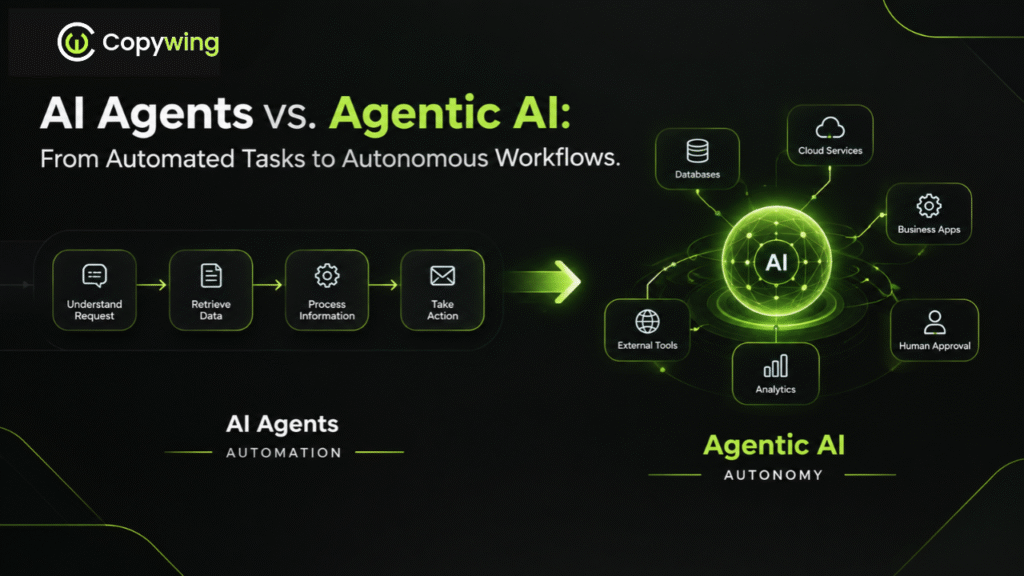
Although the terms are closely related, they are not always used to describe exactly the same thing. An AI agent can be designed to perform a specific task or workflow, while agentic AI generally refers to systems with a broader ability to reason, plan, adapt, and act toward goals with greater autonomy.
NIST describes agentic AI as systems capable of independent decision-making, goal-driven behavior, and dynamic interaction with users, systems, and environments.
For businesses, the distinction matters because moving from traditional automation to autonomous workflows changes not only what software can do, but also how organizations need to design, secure, monitor, and govern that software.
What Are AI Agents?
An AI agent is a software system that can perform tasks on behalf of a user or organization.
A traditional AI application may wait for a prompt before generating an answer. An AI agent can take a broader instruction and use available tools to complete the requested task.
For example, imagine a sales team asks an AI system to prepare a follow-up campaign for leads generated during the previous week.
Instead of simply generating an email, an AI agent could retrieve the relevant lead records, categorize them, check previous interactions, draft personalized messages, and prepare the campaign for human approval.
The important difference is action.
The system is not only producing information. It is interacting with other systems and carrying out steps within a defined workflow.
NIST’s agent terminology similarly describes software agents as systems that can interact with their environment, receive information, and undertake self-directed actions toward an externally specified goal.
What Is Agentic AI?
Agentic AI is a broader concept describing AI systems designed around goal-oriented behavior and a greater degree of autonomy.
Instead of thinking of agentic AI as a single feature, it is more useful to think of it as an architecture or approach in which AI can:
- Understand a goal
- Break the goal into smaller tasks
- Decide which actions are required
- Use tools and external systems
- Evaluate intermediate results
- Adjust its approach when circumstances change
- Continue working until the defined objective is completed or human intervention is required
This does not mean an agentic system has unlimited independence.
In a business environment, autonomy should normally be bounded by permissions, business rules, approval requirements, security controls, and predefined objectives.
AI Agents vs. Agentic AI: What’s the Difference?
The easiest way to understand the difference is to look at scope and autonomy.
An AI agent can be built to perform a particular task or workflow.
Agentic AI describes a broader system capable of coordinating multiple actions and adapting its behavior to achieve a goal.
Consider customer support.
A basic AI agent might answer customer questions using a company knowledge base.
A more agentic system could receive a customer’s request, identify the issue, retrieve the customer’s order information, check the status in an internal system, determine the appropriate next step, initiate an approved refund workflow, update the support ticket, and notify the customer.
The second system is not simply answering a question.
It is reasoning through a workflow and taking actions across connected systems.
That distinction becomes increasingly important as organizations give AI access to business applications.
From Automation to AI Agents
Traditional automation generally follows predefined rules.
For example:
New order received → Generate invoice → Send email
The workflow is predictable because every step has already been defined.
AI-powered automation introduces more flexibility.
The system can interpret unstructured information and determine which predefined action is appropriate.
AI agents go a step further by allowing the system to select and execute tools based on the goal.
A simplified workflow might look like:
Business objective → Understand context → Plan tasks → Use tools → Evaluate results → Take next action
Agentic AI extends this concept further by allowing systems to adapt their plans as they work.
This is one reason AI agents are attracting attention across areas such as software development, customer service, sales, research, IT operations, and business administration.
NIST notes that modern agent systems combine AI models with software scaffolding that allows models to use tools and take actions beyond simply generating text.
How AI Agents Work
An AI agent usually combines several technical components rather than relying on an AI model alone.
The AI model provides language understanding, reasoning, generation, classification, or other capabilities.
The agent orchestration layer manages the workflow and determines what happens next.
The tool layer gives the agent access to external capabilities such as APIs, databases, search systems, calendars, CRMs, payment platforms, or internal business applications.
The memory or context layer helps the system maintain relevant information throughout a workflow.
Finally, the security and governance layer determines what the agent is allowed to access and which actions require approval.
This architecture is what transforms an AI model into an operational system.
A Simple Example of Agentic AI in Business
Consider an e-commerce company that wants to reduce the workload associated with customer returns.
A traditional chatbot could explain the return policy.
An AI agent could retrieve the customer’s order, determine whether the product is eligible for return, generate the required instructions, create a return request, and update the customer record.
A more agentic workflow could go further.
The system could monitor the request, check the return status, communicate with the customer if information is missing, coordinate with the warehouse system, and escalate exceptions to a human support representative.
The AI is no longer limited to one interaction.
It is coordinating a business process.
Where AI Agents Are Being Used
AI agents can be applied wherever a workflow involves information gathering, decision-making, and multiple actions.
Customer Service
AI agents can retrieve customer information, search knowledge bases, classify support requests, update tickets, and handle approved service workflows.
Sales
Sales agents can research prospects, organize CRM data, prepare account summaries, draft outreach, and assist sales teams with follow-up workflows.
Recruitment
AI recruiting agents can help source candidates, organize profiles, prepare screening summaries, communicate with applicants, and coordinate interviews.
Software Development
Development agents can assist with code generation, debugging, testing, documentation, and repository workflows.
IT Operations
AI agents can monitor systems, investigate alerts, retrieve logs, and initiate predefined remediation workflows.
Finance and Operations
Agents can help process documents, reconcile information, prepare reports, and move data between approved business systems.
The value depends on how well the agent fits the organization’s actual workflow.
Multi-Agent AI Systems
Not every complex workflow needs one large AI agent.
Businesses can also create multi-agent systems, where multiple specialized agents collaborate.
For example, an e-commerce organization might use:
Research Agent → Customer Support Agent → Order Agent → Finance Agent → Notification Agent
Each agent has a defined role and access to specific tools.
A central orchestration layer can coordinate their activities.
NIST’s AI-agent security material distinguishes single-agent and multi-agent systems, with multi-agent systems involving multiple agents working together to understand context, plan, coordinate actions, and execute tasks. (NIST Computer Security Resource Center)
This approach can make complex systems easier to organize, but it also introduces additional communication, security, monitoring, and failure-management requirements.
Why Businesses Are Moving Toward Agentic Workflows
Traditional software is excellent when the workflow is predictable.
But many business processes involve unstructured information and exceptions.
A customer may ask an unexpected question.
A sales lead may not fit the usual qualification criteria.
A software issue may require investigation across multiple systems.
An employee request may involve several departments.
Agentic systems can potentially handle some of this variability because they can interpret context and select actions dynamically.
McKinsey’s research describes a growing model of organizations in which people and AI agents work together across business processes, while noting that many organizations are still in the early stages of scaling these systems.
Benefits of AI Agents and Agentic AI
The main business opportunity is not simply reducing the number of human actions.
The bigger opportunity is reorganizing workflows.
AI agents can help reduce repetitive work, connect disconnected systems, accelerate information processing, and provide continuous support for certain operational processes.
For example, instead of requiring an employee to move information between a CRM, spreadsheet, email system, and internal database, an agent can potentially coordinate those steps through integrations.
This can reduce manual handoffs and allow employees to focus on tasks that require judgment, communication, creativity, or accountability.
The Role of Human-in-the-Loop Systems
Autonomy does not mean humans should disappear from the workflow.
For many business applications, the better approach is controlled autonomy.
An AI agent can perform low-risk actions automatically while requesting approval for higher-impact activities.
For example, an agent might automatically draft an email but require approval before sending it.
It might identify a potential refund but require a manager’s approval before processing a large payment.
It might prepare a code change but require a developer to review and merge it.
This creates a balance between automation and accountability.
Security Challenges With Agentic AI
Giving an AI system access to tools creates a different security environment from a conventional chatbot.
An AI agent may have access to databases, APIs, email accounts, cloud services, internal documents, or business applications.
If those permissions are not properly controlled, an error or malicious instruction could result in unintended actions.
NIST has specifically identified security challenges associated with AI agents and is working on standards around agent security, interoperability, identity, and authorization.
NIST agent systems can also face risks such as prompt injection and agent hijacking, where malicious instructions contained in data or external content can influence an agent’s behavior.
For this reason, agentic AI development should include permission controls, monitoring, logging, authentication, authorization, and clear limits on what an agent can do.
AI Agent Identity and Permissions
One of the most important architectural questions is:
Who is the agent acting as?
An agent should not automatically inherit unrestricted access to every system available to an employee.
Instead, organizations can assign specific identities and permissions to individual agents.
For example, a customer-support agent may be allowed to read order information and update support tickets.
A finance agent may be allowed to access approved financial records.
A scheduling agent may be allowed to access calendars but not sensitive employee information.
NIST’s 2026 work on AI-agent identity and authorization specifically focuses on applying identity standards and authorization practices to software agents and agentic AI applications. (NIST Computer Security Resource Center)
Building an Agentic AI Solution
Developing an agentic AI system should begin with the workflow, not the AI model.
The first step is to identify a business process where employees spend significant time gathering information, making repetitive decisions, and moving data between systems.
The workflow can then be mapped from beginning to end.
Developers can identify which steps are suitable for automation, which require AI reasoning, which require deterministic business rules, and which should remain under human control.
The next stage is selecting the appropriate model and agent architecture.
The system can then be connected to approved tools and business applications.
After development, the agent needs testing in realistic scenarios, including unexpected inputs and failure conditions.
Finally, organizations should monitor the agent after deployment and continuously refine its workflows and permissions.
Key Components of an Agentic AI Architecture
A production-ready agentic system can include:
AI model: Handles language understanding, reasoning, classification, or generation.
Agent orchestration: Manages goals, tasks, state, and workflow execution.
Tool integrations: Connects the agent to APIs, databases, software platforms, and business systems.
Knowledge layer: Provides relevant company information, policies, documentation, and other approved context.
Memory: Maintains appropriate information across interactions or workflow steps.
Security layer: Controls identity, authentication, authorization, and access.
Monitoring: Tracks actions, errors, tool usage, and system performance.
Human approval layer: Routes sensitive or high-impact actions to authorized employees.
The exact architecture depends on the business use case.
AI Agents vs. Agentic AI: Which Approach Does a Business Need?
The answer depends on the workflow.
If a business needs an AI system to perform a clearly defined task, a focused AI agent may be sufficient.
For example, an agent that summarizes customer calls or schedules meetings does not necessarily need a highly autonomous architecture.
If the business wants AI to coordinate multiple systems, make intermediate decisions, adapt its workflow, and work toward a broader objective, a more agentic architecture may be appropriate.
The goal should not be maximum autonomy.
The goal should be the appropriate level of autonomy for the business process.
Cost of Developing AI Agents and Agentic AI
The development cost can vary significantly depending on the solution.
A single-purpose AI agent with one or two integrations will generally require less development than an enterprise agentic platform coordinating multiple agents, databases, APIs, business applications, security systems, and approval workflows.
Major cost factors include AI model usage, number of integrations, workflow complexity, data architecture, user volume, security requirements, monitoring, testing, cloud infrastructure, and ongoing maintenance.
Multi-agent systems can introduce additional development and operational costs because communication between agents, coordination, observability, and error handling all need to be designed.
Businesses should therefore define the workflow and technical requirements before estimating development cost.
How to Measure ROI From AI Agents
The ROI of an AI agent should be connected to measurable business outcomes.
For a customer-service agent, businesses may track response time, support volume, resolution time, and escalation rates.
For sales agents, relevant metrics could include research time, qualified opportunities, follow-up speed, and CRM productivity.
For internal operations, organizations may measure processing time, manual workload, error rates, and cost per transaction.
An agent that performs thousands of automated actions is not necessarily creating business value.
The important question is whether it improves the underlying process.
Common Mistakes When Building AI Agents
One common mistake is giving an agent too much autonomy too early.
Another is connecting an agent to business systems without carefully defining permissions.
Organizations can also underestimate the importance of monitoring.
An agent may work correctly under normal conditions but behave differently when it encounters unexpected information.
A strong implementation therefore begins with a controlled use case and gradually expands the agent’s capabilities as reliability is demonstrated.
The Future of Agentic AI
AI systems are increasingly moving from answering questions toward interacting with the software environment around them.
Instead of asking an AI to explain how to perform a task, users can increasingly expect AI systems to help execute that task.
This could change how businesses interact with software.
Rather than navigating multiple dashboards, employees may communicate an objective in natural language while AI agents coordinate the underlying systems.
The long-term shift is therefore not simply from chatbots to agents.
It is from software that waits for instructions to software that can participate in workflows.
That transition will require stronger standards for security, identity, authorization, interoperability, testing, and accountability. NIST‘s 2026 AI Agent Standards Initiative reflects the growing focus on these issues as agent systems become more capable and connected.
How CopyWing Can Help Build AI Agent Solutions
Building an AI agent requires more than integrating an AI API into a website.
The system needs a reliable application architecture, secure integrations, appropriate workflows, user permissions, monitoring, and an interface that makes the agent useful to the people operating it.
CopyWing provides web development services that include custom AI solutions, AI-powered chatbots, machine-learning integrations, automation, and cloud technologies.
For businesses exploring AI agents, these capabilities can support custom applications that connect AI with existing business systems and operational workflows.
Whether the requirement is a customer-service agent, sales automation system, internal AI assistant, recruitment agent, or a more complex agentic workflow, the development approach should be built around the organization’s actual processes and security requirements.
Businesses looking to discuss a custom AI application can connect with CopyWing to discuss their requirements.
Frequently Asked Questions
What is an AI agent?
An AI agent is a software system that can interpret a goal, use available tools, and perform actions on behalf of a user or organization.
What is agentic AI?
Agentic AI refers to AI systems designed to operate with greater autonomy, including the ability to plan, reason, adapt, use tools, and take actions toward defined goals.
Are AI agents and agentic AI the same?
The terms overlap, but they are not always interchangeable. An AI agent can perform a specific task or workflow, while agentic AI generally describes a broader approach to autonomous, goal-oriented AI behavior.
Are AI agents fully autonomous?
Not necessarily. Businesses can design agents with different levels of autonomy. Many production systems use human approval for sensitive or high-impact actions.
What is a multi-agent AI system?
A multi-agent system uses multiple specialized AI agents that coordinate with each other to complete a larger workflow or objective.
How much does it cost to build an AI agent?
Costs depend on the agent’s complexity, integrations, AI models, data, security requirements, infrastructure, testing, and maintenance. A focused single-agent application can be significantly simpler than an enterprise multi-agent platform.
Are AI agents secure?
AI agents can be secured, but they introduce additional risks because they may have access to external tools and business systems. Identity management, authorization, monitoring, logging, and controlled permissions are important parts of a production implementation.
Conclusion
AI agents and agentic AI represent an important shift in how businesses can use artificial intelligence.
Traditional automation follows predefined instructions. AI agents can interpret goals and use tools to complete tasks. Agentic AI takes this concept further by enabling systems to plan, adapt, coordinate actions, and work toward broader objectives with a greater degree of autonomy.
For businesses, the opportunity is not simply to automate more tasks.
It is to redesign workflows around a combination of AI capabilities, software integrations, business rules, and human oversight.
The most effective implementations will not necessarily be the systems with the highest level of autonomy. They will be the systems where autonomy is applied carefully to the right processes, with clear permissions, measurable objectives, strong security, and human control where it matters.