Insurance companies manage enormous amounts of customer and policy information.
From leads and policy details to claims, renewals, customer conversations, documents, payments, and service requests, insurance businesses often have data spread across multiple systems.
A traditional CRM can organize much of this information.
But AI in insurance CRM takes customer management a step further.
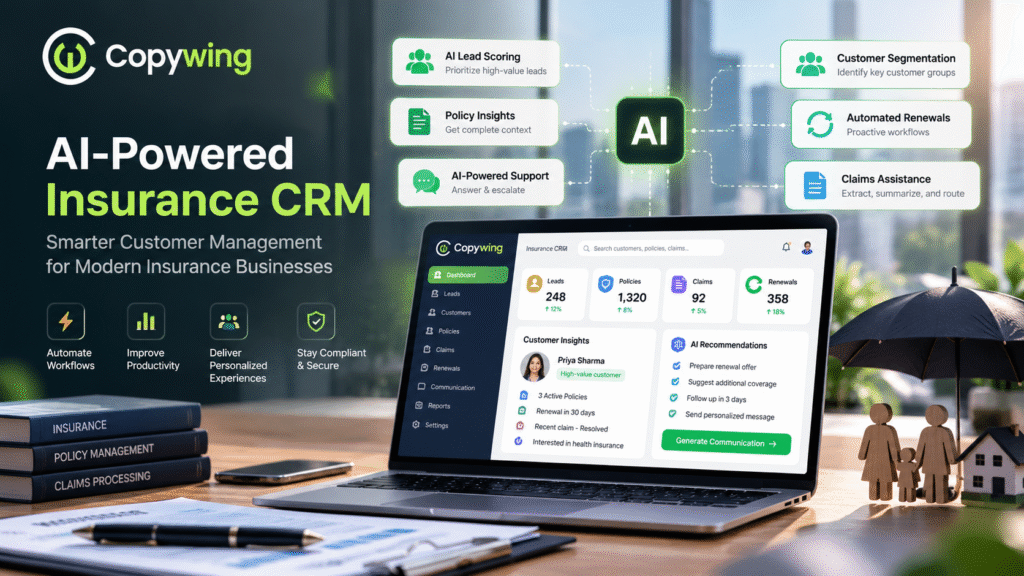
Instead of simply storing customer records, an AI-powered CRM can analyze information, identify patterns, summarize conversations, automate repetitive workflows, assist sales teams, and help employees determine what action should come next.
The opportunity is already significant. The National Association of Insurance Commissioners (NAIC) notes that insurers are using AI across areas including underwriting, pricing, customer service, claims handling, marketing, and fraud detection. At the same time, regulators continue focusing on fairness, accuracy, consumer protection, governance, and human oversight. (NAIC Content)
For insurance companies, the question is no longer simply whether AI can be added to a CRM.
The more important question is:
How can AI make an insurance CRM more useful without compromising customer trust, security, or regulatory requirements?
What Is an Insurance CRM?
An insurance CRM is a customer relationship management platform designed around the needs of insurance businesses.
It can help insurers and insurance agencies manage information related to:
- Leads
- Customers
- Agents
- Policies
- Customer communications
- Renewals
- Service requests
- Sales opportunities
- Claims-related interactions
A traditional CRM primarily helps employees store, organize, and retrieve information.
An AI-powered CRM can go further by helping employees interpret information and automate actions.
For example, instead of simply showing that a customer’s policy expires in 30 days, an AI-enabled CRM could identify the upcoming renewal, summarize the customer’s history, prepare a personalized communication, and recommend a follow-up action.
That changes the CRM from a record-keeping system into a more intelligent workflow platform.
Why Is AI Becoming Important in Insurance CRM?
Insurance is highly dependent on information.
Employees need to understand customer histories, policy details, previous interactions, claims, preferences, and other data before making decisions or responding to customers.
At the same time, customers increasingly expect faster and more personalized digital experiences.
The NAIC’s current insurance technology guidance notes that AI and other technologies are reshaping areas such as customer interaction, claims, product design, and risk assessment, while also introducing concerns around sensitive data, cybersecurity, bias, and transparency. (NAIC Content)
AI can help address some of these operational challenges.
For example, it can reduce the amount of manual work required to find information, summarize customer conversations, prioritize leads, and initiate routine follow-ups.
The goal isn’t necessarily to replace insurance professionals.
Instead, AI can give them better information and automate repetitive tasks so they can spend more time on complex customer and business decisions.
Key Features of an AI-Powered Insurance CRM
An effective AI insurance CRM can combine traditional CRM capabilities with intelligent automation and analytics.
AI Lead Scoring
Insurance companies can receive leads from websites, advertising campaigns, referrals, agents, comparison platforms, and other sources.
Manually reviewing every lead can consume considerable sales-team time.
AI-powered lead scoring can analyze available information and help prioritize prospects based on predefined business criteria.
For example, the system could identify leads that show stronger purchase intent or are more closely aligned with a particular insurance product.
The sales team can then focus its attention where it is most likely to create value.
Customer Segmentation
Not every insurance customer has the same needs.
An AI CRM can analyze customer information and interactions to identify useful segments.
For example:
- New customers
- Customers approaching renewal
- High-value customers
- Customers with multiple policies
- Customers who frequently contact support
- Customers who may need additional assistance
These segments can support more relevant communication and better customer-service workflows.
AI-Powered Customer Support
Insurance customers often ask repetitive questions about policies, documents, renewals, claims, payments, and procedures.
An AI-powered CRM can connect customer conversations with relevant CRM information and approved knowledge sources.
A virtual assistant might answer simple questions while escalating more complicated requests to a human employee.
This can create a workflow such as:
Customer question → AI understands request → CRM retrieves relevant information → AI prepares response → Human escalation when required
AI should not simply generate answers without context. The system should be connected to trusted information sources and designed to escalate uncertain or high-impact cases.
Customer Conversation Summarization
Insurance employees may have to review long customer conversations before responding to a request.
AI can summarize important information from emails, calls, chats, and previous interactions.
For example, an employee opening a customer record could see:
Customer issue → Previous conversations → Policy context → Actions already taken → Recommended next step
This can reduce the amount of time employees spend searching through historical records.
Automated Renewal Management
Policy renewal is one of the most natural use cases for AI-powered CRM automation.
Instead of relying entirely on employees to remember upcoming renewals, the CRM can identify policies approaching expiration and initiate predefined workflows.
A workflow might look like:
Renewal approaching → Customer history analyzed → Communication prepared → Customer contacted → Follow-up scheduled → Agent review
AI can also help personalize the communication based on the customer’s history and relationship with the insurer.
AI in Insurance Claims Management
Claims are often among the most information-intensive insurance workflows.
Employees may need to review documents, customer records, previous communications, policy information, and claim details.
AI can assist with parts of this process by:
- Extracting information from documents
- Summarizing claim histories
- Identifying missing information
- Organizing case information
- Routing cases to appropriate teams
- Preparing customer communications
- Supporting claims employees with relevant information
AI is already being explored across insurance claims and other core insurance processes. The NAIC’s current AI materials specifically identify claims handling as one of the areas where insurers use AI. (NAIC Content)
However, businesses should distinguish between AI assistance and fully automated decision-making.
A system can help an employee review a claim without being given unrestricted authority to make every final decision.
AI-Powered Insurance CRM Personalization
Insurance customers increasingly expect digital experiences that feel relevant to their individual circumstances.
An AI CRM can analyze customer interactions and help personalize communication across different stages of the customer journey.
For example, the system could identify that a customer:
- Has multiple insurance products
- Is approaching renewal
- Recently contacted support
- Has shown interest in another product
- Has changed their communication preferences
The CRM can then help employees or automated workflows provide more relevant information.
The objective should not be personalization for its own sake.
The goal is better timing, better context, and more useful communication.
AI Insurance CRM Integration
An insurance CRM rarely operates in isolation.
A modern insurance technology environment may include:
- Policy administration systems
- Claims platforms
- Customer portals
- Payment systems
- Email platforms
- SMS systems
- Document management
- Marketing automation
- Analytics platforms
- AI services
- Internal databases
Connecting these systems is critical if an AI CRM is expected to provide meaningful information.
For example, a customer-service agent should ideally not have to manually open five different applications to answer a simple question.
A connected architecture can bring relevant information together.
For businesses that need custom applications, API integrations, AI-powered workflows, and connected business platforms, CopyWing’s Website Development Services can support custom web and software development requirements.
How Does Insurance CRM Integration Work?
A simplified architecture can look like this:
Customer Interaction
↓
AI / CRM Layer
↓
Integration & API Layer
↓
Policy System + Claims System + Customer Database + Payment System
↓
Unified Customer Information
The CRM becomes the central workspace while integrations provide access to information stored elsewhere.
This approach can reduce data silos and help employees work with more complete customer context.
AI Insurance CRM and Data Privacy
Insurance companies handle sensitive customer information, which makes privacy and data governance particularly important.
An AI system may process information related to:
- Personal identity
- Policy information
- Financial information
- Customer communications
- Claims
- Health-related information, depending on the insurance line
The NAIC continues to work on insurance data privacy and consumer protections, including issues around collection, ownership, use, disclosure, consent, and sensitive personal information. (NAIC Content)
An AI insurance CRM should therefore include appropriate controls around:
- Data access
- User permissions
- Authentication
- Encryption
- Audit logs
- Data retention
- Consent
- Third-party integrations
- AI model access
Not every employee or AI workflow should automatically have access to every customer record.
AI Governance in Insurance CRM
AI governance is particularly important when AI influences insurance-related decisions.
For example, an AI system may help prioritize customers, evaluate information, detect potential fraud, or support claims and underwriting workflows.
These use cases require more than technical accuracy.
Insurers also need to consider fairness, explainability, accountability, regulatory compliance, and human oversight.
The NAIC’s Model Bulletin on the Use of Artificial Intelligence Systems by Insurers establishes expectations around responsible AI use and reminds insurers that AI-supported decisions must comply with applicable insurance laws and regulations. (NAIC Content)
This means AI should be treated as part of the organization’s governance framework—not simply another software feature.
How to Implement AI in an Insurance CRM
Businesses should avoid starting with:
“Which AI model should we use?”
A better starting point is:
“Which insurance CRM workflow creates the biggest business problem?”
For one company, it may be lead prioritization.
For another, it may be customer-service response time.
For another, it could be renewal management or claims-document processing.
Once the highest-value workflow is identified, the AI implementation becomes much easier to define.
AI Insurance CRM Development Process
1. Identify the Business Problem
Document the current CRM workflow and identify where employees spend the most time.
2. Map the Existing Technology Stack
Identify CRM systems, policy platforms, claims systems, databases, APIs, and customer-facing applications.
3. Select the AI Use Case
Choose a use case with measurable business value.
4. Assess the Data
Determine what information is available, where it is stored, how accurate it is, and whether it can be used for the intended purpose.
5. Design the Integration Architecture
Define how the CRM will communicate with external systems and AI services.
6. Build the AI Workflow
Develop the required models, prompts, automation, integrations, dashboards, and user experiences.
7. Add Security and Governance
Define permissions, monitoring, auditability, human approval, and data-protection controls.
8. Test the System
Test accuracy, security, edge cases, integration failures, and inappropriate outputs.
9. Launch and Monitor
Start with a controlled rollout and monitor both technical performance and business outcomes.
Benefits of AI in Insurance CRM
When implemented correctly, AI can improve several areas of insurance operations.
Better Employee Productivity
Employees spend less time searching for information and completing repetitive CRM tasks.
Faster Customer Service
AI can help retrieve relevant information and prepare responses more quickly.
More Effective Lead Management
Sales teams can prioritize leads instead of manually reviewing every prospect.
Better Customer Personalization
Customer communication can become more contextual and relevant.
Improved Workflow Automation
Routine activities such as reminders, follow-ups, summaries, and routing can be automated.
Better Decision Support
Employees can receive summaries, recommendations, and relevant information at the point of action.
The value, however, depends on how well the AI system is integrated with actual business processes.
AI Insurance CRM ROI: What Should Businesses Measure?
AI CRM ROI should not be measured only by the number of AI interactions.
Businesses should connect the implementation to measurable operational outcomes.
Useful metrics include:
- Lead conversion rate
- Customer response time
- Customer service resolution time
- Employee productivity
- Renewal rate
- Cost per customer interaction
- Manual processing time
- Customer satisfaction
- Cross-sell opportunities
- Number of automated workflows
For example, if employees previously spent several hours each day preparing customer summaries and AI reduces that workload significantly, the resulting time savings can be translated into an operational ROI calculation.
How Much Does AI Insurance CRM Development Cost?
There is no fixed development price for an AI insurance CRM.
A basic AI assistant connected to an existing CRM is very different from a complete insurance platform involving claims, policy management, analytics, customer portals, AI automation, and multiple third-party integrations.
The major cost factors usually include:
- CRM complexity
- Number of integrations
- AI functionality
- Data volume
- Cloud infrastructure
- Security requirements
- User volume
- Custom dashboards
- Automation complexity
- Compliance requirements
- Ongoing maintenance
A practical strategy is to start with one high-value workflow rather than attempting to transform the entire CRM at once.
AI Insurance CRM vs Traditional CRM
The biggest difference is how the system handles information.
| Capability | Traditional CRM | AI-Powered Insurance CRM |
|---|---|---|
| Customer records | Stores information | Stores and analyzes information |
| Lead management | Rule-based/manual | AI-assisted prioritization |
| Customer support | Agent-driven | AI-assisted + human support |
| Data analysis | Manual/report-based | AI-assisted insights |
| Communication | Templates | Context-aware assistance |
| Workflow | Predefined automation | AI-assisted workflows |
| Summarization | Manual | AI-generated summaries |
| Recommendations | Basic rules | AI-supported recommendations |
The goal isn’t necessarily to replace traditional CRM functionality.
Instead, AI adds an intelligence layer on top of existing CRM capabilities.
Common Challenges of AI Insurance CRM
Data Quality
AI is only as useful as the information it receives.
Duplicate, outdated, incomplete, or inconsistent customer data can reduce the quality of AI outputs.
Integration Complexity
Insurance companies often operate multiple legacy systems, making integration one of the biggest technical challenges.
Privacy and Security
Sensitive customer information requires strong controls around access, storage, processing, and third-party services.
AI Accuracy
AI-generated information can be incorrect or incomplete. Important customer and insurance decisions therefore require appropriate validation.
Regulatory Requirements
Insurance AI applications may need to satisfy applicable regulatory and consumer-protection requirements.
Employee Adoption
Even technically strong systems can fail if employees do not understand how to use them.
How to Make an AI Insurance CRM Successful
A successful implementation should focus on the workflow rather than the AI feature itself.
Start small.
Choose one measurable problem.
For example:
“Reduce customer-service response preparation time by 40%.”
Then design the AI workflow around that objective.
Once the system proves its value, additional workflows can be added.
This approach reduces implementation risk and gives the business measurable results before making a larger technology investment.
The Future of AI Insurance CRM
The future of insurance CRM is moving beyond simply storing customer information.
Traditional CRM answers:
“What information do we have about this customer?”
AI-powered CRM can increasingly help answer:
“What is happening with this customer, what matters right now, and what should happen next?”
As AI becomes more integrated into insurance operations, CRM platforms may increasingly connect customer data, policy information, claims workflows, communication, analytics, and intelligent automation.
At the same time, responsible AI will remain critical. Current NAIC work continues to focus on AI evaluation, governance, risk mitigation, data quality, and regulatory oversight. (NAIC Content)
That means the strongest insurance CRM platforms will not simply be the ones with the most AI features.
They will be the ones that combine useful automation, reliable data, strong integrations, security, governance, and human oversight.
FAQs About AI in Insurance CRM
What is AI in insurance CRM?
AI in insurance CRM means using artificial intelligence within customer relationship management systems to analyze customer information, automate workflows, assist employees, personalize communication, and support insurance-related operations.
What are the main benefits of an AI-powered insurance CRM?
The main benefits can include improved employee productivity, faster customer service, better lead prioritization, automated follow-ups, customer personalization, and AI-assisted decision support.
Can AI be used for insurance claims?
Yes. AI can assist with tasks such as document processing, information extraction, claim summarization, case routing, and customer communication. However, the level of automation should depend on the risk and business context.
Can AI automate insurance customer support?
AI can automate many routine customer-support interactions, such as answering common questions or retrieving approved information. More complex or sensitive issues should be escalated to human representatives when appropriate.
How does AI improve insurance lead management?
AI can analyze available lead information and help sales teams prioritize prospects based on predefined criteria, potentially reducing the amount of manual lead qualification.
Is AI insurance CRM secure?
It can be designed securely, but AI does not automatically make a CRM secure. Organizations need appropriate authentication, authorization, encryption, monitoring, data governance, and access controls.
How much does an AI insurance CRM cost?
The cost depends on the number of integrations, AI capabilities, data complexity, security requirements, infrastructure, users, and customization. A small AI enhancement to an existing CRM will generally require much less development than a complete custom insurance platform.
Does AI replace insurance employees?
Not necessarily. AI is often more valuable as an employee-assistance and automation layer. The NAIC notes that AI is more likely to support insurance workers than replace them entirely, with human judgment remaining important in many insurance activities. (NAIC Content)
What systems can an AI insurance CRM integrate with?
Depending on the architecture, it can integrate with policy administration systems, claims platforms, payment systems, customer portals, databases, analytics platforms, marketing tools, communication systems, and other APIs.
How should a company start implementing AI in its CRM?
Start with one specific workflow that has a measurable business problem. Define the desired outcome, assess the available data, map the required integrations, build a controlled AI workflow, and expand after measuring the results.
Conclusion
AI in insurance CRM is changing the role of customer relationship management from a system that primarily stores information into a platform that can help employees understand customers, automate workflows, and make better use of business data.
From lead scoring and customer support to renewal management, claims assistance, personalization, and workflow automation, AI can create value across multiple stages of the insurance customer journey.
But successful implementation requires more than adding an AI chatbot.
Insurance companies need reliable data, strong integrations, secure architecture, responsible AI governance, and appropriate human oversight.
For businesses planning an AI-powered insurance CRM, the most practical approach is to start with a specific workflow, measure its business impact, and gradually expand the system as value is demonstrated.
That is how AI can become a useful part of the insurance technology stack rather than simply another feature.