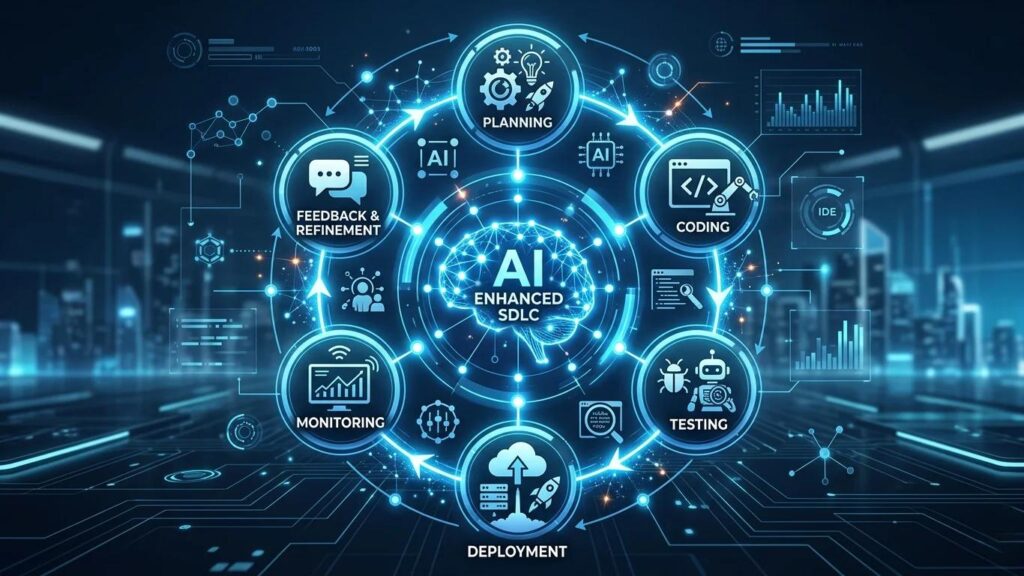
Software development is entering a new phase. AI tools are no longer limited to suggesting code, explaining errors, or helping developers write functions faster. They are increasingly becoming part of the entire software development lifecycle, from understanding business requirements and designing architecture to testing applications, reviewing code, and supporting deployment.
This shift is driving interest in the AI-native SDLC, an approach in which artificial intelligence is built into the way software teams plan, develop, test, release, and maintain applications.
As businesses look toward 2027, the conversation is moving beyond whether developers should use AI. The bigger question is how organizations can redesign their development workflows to make AI useful, secure, measurable, and reliable at scale.
In this guide, we explore what AI-native SDLC means, how it differs from traditional software development, the technologies behind it, its business benefits, implementation challenges, and the steps companies can take to prepare for the next generation of software engineering.
What Is AI-Native SDLC?
AI-native SDLC refers to a software development lifecycle designed around AI capabilities from the beginning. Instead of adding an AI coding assistant to an otherwise unchanged workflow, teams integrate AI into multiple stages of the development process.
In a traditional software development lifecycle, developers typically gather requirements, design the system, write code, conduct testing, deploy the application, and maintain it. Automation may support certain activities, but many decisions and handoffs still depend on manual work.
An AI-native approach introduces intelligent assistance and, where appropriate, AI agents across these stages. An AI system might summarize requirements, suggest architectural options, generate a test plan, identify potential defects, or prepare a code change for human review.
The important distinction is that AI-native development is not simply about generating more code. It is about improving the complete system through which software is designed, built, validated, and delivered.
For example, a development team building a customer portal could use AI to analyze user stories, identify missing acceptance criteria, generate an initial implementation, create test cases, and summarize findings from code review. Developers remain responsible for validating the output and making important engineering decisions.
AI-native SDLC therefore combines AI capabilities with established engineering practices, including version control, automated testing, security reviews, deployment controls, and production monitoring.
AI-Assisted Development vs. AI-Native SDLC
AI-assisted development and AI-native SDLC are related, but they represent different levels of adoption.
AI-assisted development usually means that individual developers use AI tools to complete specific tasks. They might generate a function, troubleshoot an error, write documentation, or create unit tests. The broader workflow remains largely unchanged.
AI-native SDLC takes a more comprehensive approach. It considers how AI can contribute across the lifecycle and how information, approvals, tools, and feedback should flow between people and AI systems.
The difference becomes clearer when we compare their operating models.
| Area | AI-assisted development | AI-native SDLC |
|---|---|---|
| Planning | AI helps summarize requirements | AI supports requirement analysis and planning workflows |
| Coding | Developers request code suggestions | AI can contribute to coordinated implementation tasks |
| Testing | AI generates individual test cases | AI supports broader test planning, execution, and failure analysis |
| Code review | AI provides suggestions | AI-assisted review integrates with established approval policies |
| Deployment | Existing release workflow | AI may assist with release preparation and operational analysis |
| Governance | Often focused on tool usage | Policies, permissions, validation, and monitoring span the lifecycle |
| Measurement | Code-generation speed | Delivery performance, quality, reliability, security, and business outcomes |
AI-native does not mean removing developers from the process or allowing agents to control every stage independently. It means designing workflows in which AI has a defined role, appropriate access, and measurable responsibilities.
Why AI-Native SDLC Matters in 2027
The growing use of AI in engineering creates an opportunity to rethink how software teams operate. Faster code generation is useful, but it does not automatically produce better software or faster business outcomes.
The 2025 DORA research on AI-assisted software development emphasizes that AI can amplify existing organizational strengths and weaknesses. Teams with effective engineering practices may be better positioned to benefit, while weak processes can create additional problems when AI increases the volume of work.
This is why businesses preparing for 2027 should focus on the development system around AI rather than treating AI tools as a standalone productivity solution.
Faster software delivery
AI can reduce the time spent on repetitive engineering tasks, such as generating boilerplate code, drafting documentation, creating test data, and analyzing routine errors. This can help teams spend more time on architecture, product decisions, and complex technical problems.
The actual time savings depend on task complexity, codebase quality, tool capabilities, and the amount of review required.
Better use of engineering expertise
Experienced developers often spend considerable time understanding unfamiliar code, investigating defects, and reviewing changes. AI can assist with these tasks by summarizing relevant files, explaining dependencies, and suggesting possible solutions.
This can make technical knowledge easier to access, particularly in large projects or teams maintaining legacy applications.
More consistent development workflows
AI-enabled workflows can help standardize documentation, code review checklists, test generation, and issue classification. When combined with established engineering standards, these capabilities can reduce inconsistencies across teams.
However, consistency depends on the quality of the underlying rules, context, and validation mechanisms.
Earlier identification of defects
AI can help developers identify suspicious code patterns, missing test scenarios, and potential edge cases earlier in development. Early feedback gives teams more opportunities to fix problems before they affect production.
AI findings should still be validated through reliable testing and security controls. A confident AI response is not proof that an application is correct.
How AI Is Changing Each Stage of the Software Development Lifecycle
The most significant change in AI-native SDLC is the way intelligence becomes available throughout the development process instead of being restricted to the coding stage.
1. AI-Powered Requirement Analysis
Software projects often begin with business requirements expressed through meetings, documents, user stories, and stakeholder discussions. These inputs may contain ambiguity, conflicting expectations, or missing details.
AI can help analyze requirement documents, summarize discussions, identify dependencies, and highlight questions that need clarification before implementation begins.
For example, if a business requests an online appointment booking system, AI could help identify requirements related to user registration, appointment availability, cancellation rules, reminders, and administrator permissions.
It can also suggest acceptance criteria and potential edge cases for product owners to review.
The goal is not to let AI decide what the business needs. It is to help stakeholders discover gaps earlier and make requirements easier for engineering teams to understand.
2. AI-Assisted Architecture and System Design
Architecture decisions influence application scalability, maintainability, security, and operating costs. AI can support architects by comparing design alternatives, identifying dependencies, and explaining trade-offs.
A team designing a new SaaS application might use AI to explore whether a modular monolith or microservices architecture is appropriate. It could also help draft API specifications, document system components, or identify potential integration challenges.
The final design should account for workload, team capabilities, existing infrastructure, compliance requirements, and long-term maintenance.
AI-generated architecture recommendations should be treated as proposals rather than authoritative decisions. Architects still need to validate assumptions and evaluate the consequences of each design choice.
3. AI-Native Coding and Implementation
Coding is one of the most visible applications of AI in software development. AI coding assistants can generate code, explain unfamiliar functions, suggest refactoring opportunities, and help developers work across multiple files.
As coding agents evolve, some can also execute bounded tasks using approved tools. Depending on the environment, an agent may inspect a repository, modify files, run tests, and propose a change for review.
This changes the developer’s role from writing every line manually to directing work, reviewing implementation choices, and ensuring that the result meets technical and business requirements.
For AI-generated code to be useful, teams need clear specifications, access to relevant project context, automated tests, code review, and appropriate security checks. Otherwise, faster generation can simply create more code that engineers must repair later.
4. AI-Powered Software Testing
Testing is another important part of AI-native SDLC. AI can help generate unit tests, propose integration scenarios, analyze test failures, and identify areas where existing coverage may be insufficient.
For example, an e-commerce application may require testing for discount combinations, inventory updates, payment failures, duplicate orders, and interrupted checkout sessions. AI can help suggest additional scenarios based on the requirements and implementation.
AI can also assist with failure triage by grouping similar errors and summarizing likely causes.
Nevertheless, test generation and test execution are different activities. A generated test may be incomplete, incorrect, or based on the same misunderstanding as the code being tested. Teams should maintain independent assertions, regression suites, and appropriate quality gates.
5. AI-Assisted Code Review and Security
Code review helps teams detect defects, enforce coding standards, and evaluate the impact of changes. AI can make this process more efficient by explaining complex diffs, identifying suspicious patterns, and highlighting missing validation or error handling.
Security-focused workflows can also use automated analysis to flag potential vulnerabilities, insecure dependencies, exposed credentials, and unsafe data handling.
These tools are most effective when they complement established security practices rather than replace them. Static analysis, dependency scanning, secret detection, threat modeling, and human review still have important roles.
AI-generated changes should be subject to the same quality and security requirements as manually written code.
6. AI in Deployment and DevOps
AI-native SDLC extends beyond development into release preparation and operations.
AI can summarize deployment changes, interpret build failures, identify unusual monitoring signals, and help engineers investigate incidents. Agents may prepare release notes or recommend corrective actions based on approved operational data.
More autonomous actions require stronger safeguards. Production deployments, database migrations, infrastructure changes, and rollback decisions can have significant consequences.
Teams should define which tasks AI can perform independently, which require approval, and which must remain restricted to authorized operators.
7. AI-Powered Maintenance and Modernization
Software maintenance includes bug fixes, dependency updates, performance improvements, documentation, and legacy modernization. These tasks can be difficult because the original design decisions may not be documented clearly.
AI can help explain legacy code, map dependencies, identify duplicated logic, and propose incremental refactoring plans.
For example, a business modernizing an older application could use AI to help document existing behavior before migrating selected components to a newer architecture.
The key is to preserve important business rules while making controlled improvements. Automated changes should be validated against regression tests and real operational requirements.
Key Technologies Behind AI-Native SDLC
An effective AI-native development environment combines multiple technologies. No single AI model or coding assistant is sufficient to manage every stage of the lifecycle.
Large language models
Large language models support tasks involving natural language, code understanding, documentation, reasoning, and content generation. They can help interpret requirements, explain implementation options, and generate initial code or tests.
Model selection should account for accuracy, context limits, latency, cost, privacy, and performance on the team’s actual engineering tasks.
AI coding assistants and agents
Coding assistants generally respond to developer requests within a development environment. Coding agents may take a more active role by planning tasks, using tools, editing files, and executing commands within defined permissions.
Organizations should evaluate whether a tool can work reliably with their repositories, development standards, and review processes before expanding its responsibilities.
Retrieval-augmented generation and codebase context
AI tools produce more relevant results when they have access to the right information. Retrieval-augmented generation, repository indexing, and documentation search can help provide context from approved internal sources.
Useful context may include architecture documents, API specifications, coding standards, issue histories, and relevant source files.
Access must be controlled carefully. AI systems should not retrieve confidential information simply because it exists somewhere in the organization.
CI/CD and automated testing
Continuous integration and continuous delivery pipelines provide repeatable checks for software changes. AI-native workflows can integrate with these pipelines to generate tests, interpret failures, or prepare proposed fixes.
The pipeline should remain responsible for executing the required checks. AI-generated explanations can help engineers understand results, but they should not silently override failed security or quality gates.
Observability and feedback systems
Logs, metrics, traces, user feedback, and incident records help teams understand how applications behave after release.
AI can help summarize this information and identify patterns that deserve investigation. The value depends on accurate telemetry, reliable access controls, and a clear process for validating recommendations.
AI-Native SDLC Architecture: How the Components Work Together
An AI-native engineering environment needs more than a model connected to a code editor. It needs a controlled architecture that connects development context, approved tools, automated checks, and human decisions.
A typical architecture includes the following layers:
1. Developer and planning layer: Product requirements, issue trackers, design documents, and developer interfaces define the work to be completed.
2. Context layer: Approved repositories, documentation, APIs, architecture decisions, and coding standards provide relevant project information.
3. AI orchestration layer: Models and agents interpret tasks, select approved tools, coordinate bounded activities, and return proposed results.
4. Execution layer: Development environments, version control, build systems, test runners, and CI/CD pipelines execute engineering tasks.
5. Governance layer: Identity controls, permissions, audit logs, secret management, security policies, and approval rules limit what AI systems can access or change.
6. Monitoring and feedback layer: Quality metrics, production telemetry, test outcomes, and developer feedback help teams evaluate results and improve workflows.
These layers work together to keep AI useful without giving it unrestricted control over the engineering environment.
For example, an AI agent could receive a task to fix a validation bug, inspect the relevant code and requirements, propose a change, run approved tests, and submit a pull request. A developer then reviews the change, while the CI/CD pipeline independently verifies the required checks.
This model combines AI assistance with repeatable engineering controls.
Benefits of AI-Native Software Development for Businesses
The business value of AI-native SDLC depends on the outcomes an organization needs to improve. Faster code generation is only one possible benefit.
Reduced repetitive engineering work
AI can help automate routine tasks that consume developer time, including documentation, test scaffolding, code explanations, and issue summaries. This can allow engineering teams to focus more heavily on product functionality and complex problems.
Faster feedback during development
AI-assisted analysis and automated testing can help developers discover issues sooner. Shorter feedback loops can reduce the time between introducing a defect and understanding its cause.
Improved access to technical knowledge
Teams can use AI to search approved documentation, understand legacy code, and summarize implementation details. This can make onboarding and cross-team collaboration easier.
More efficient software maintenance
AI can help identify duplicated code, propose refactoring, and assist with dependency upgrades. These capabilities may help organizations manage older applications without relying exclusively on manual investigation.
Better alignment between engineering and business goals
When AI workflows are connected to requirements, acceptance criteria, and measurable outcomes, teams can better evaluate whether development work solves the intended business problem.
These benefits are not automatic. Organizations should measure actual improvements in delivery time, defect rates, reliability, developer experience, and operating costs rather than assuming that AI adoption itself guarantees productivity gains.
Challenges of Implementing AI-Native SDLC
AI-native development introduces new engineering opportunities, but it also creates challenges that businesses need to address before scaling adoption.
Code quality and technical debt
AI can produce code quickly, but generated code may contain unnecessary complexity, duplicated logic, or incorrect assumptions. Without strong review and testing practices, teams can accumulate technical debt faster.
The solution is to maintain clear engineering standards and require appropriate validation for every change.
Security and confidential information
AI tools may interact with source code, credentials, customer data, or internal documents. Organizations need clear policies for data access, retention, approved tools, and the handling of sensitive information.
AI agents also introduce risks when they can execute commands or interact with external systems. Permissions should follow the principle of least privilege, and sensitive actions should require stronger controls.
Unreliable or incorrect outputs
AI systems can produce plausible explanations that are incomplete or wrong. They may misunderstand business requirements, invent APIs, overlook edge cases, or recommend unsuitable architecture.
Teams should verify results through independent tests, code review, documentation checks, and measurable acceptance criteria.
Integration with existing systems
Many businesses use established repositories, issue trackers, build pipelines, cloud platforms, and security tools. Integrating AI across these systems can be difficult when interfaces, permissions, and workflows differ.
A phased rollout focused on a well-defined use case is usually easier to evaluate than a large-scale transformation launched all at once.
Measuring real productivity
More generated code does not necessarily mean faster delivery. AI may reduce time spent writing code while increasing review effort, debugging, or rework.
Businesses should measure the complete workflow, including the time required to validate and maintain AI-generated changes.
How to Implement AI-Native SDLC in Your Organization
Organizations do not need to rebuild their entire development process to start adopting AI-native practices. A structured rollout can help teams identify where AI creates measurable value and where additional controls are needed.
Step 1: Assess the existing SDLC
Document how requirements move through planning, development, testing, review, deployment, and maintenance. Identify recurring delays, manual tasks, quality issues, and integration bottlenecks.
This assessment creates a baseline against which improvements can be measured.
Step 2: Select a suitable pilot project
Choose a bounded workflow with clear success criteria. Examples include generating unit tests for a specific module, summarizing pull requests, assisting with documentation, or investigating recurring build failures.
Avoid beginning with unrestricted access to critical production systems.
Step 3: Define AI responsibilities and boundaries
Specify which tasks AI can suggest, which it can execute in a controlled environment, and which require human approval.
For example, an AI agent may be permitted to edit a feature branch and run tests, while merging code or deploying to production remains subject to existing approval rules.
Step 4: Prepare project context and engineering standards
Provide approved documentation, architecture guidance, coding conventions, and test requirements. Remove outdated instructions and establish a clear source of truth for important technical decisions.
Good context helps AI produce more relevant results and reduces unnecessary rework.
Step 5: Integrate AI with existing development tools
Connect the selected AI workflow to the systems it actually needs, such as a repository, issue tracker, test runner, or CI pipeline. Limit access to the minimum required for the task.
Organizations planning new applications or modernizing existing platforms can explore CopyWing’s website development services to understand its development and AI integration capabilities.
Step 6: Establish validation and security controls
Define mandatory tests, code review requirements, dependency checks, secret scanning, and approval policies. Record AI-driven actions where appropriate so the team can investigate failures and understand how changes were made.
Validation should be independent enough to catch mistakes that may also appear in the AI’s original reasoning.
Step 7: Measure results and expand gradually
Compare the pilot against the baseline. Track delivery time, review effort, escaped defects, build failures, security findings, and developer feedback.
If the workflow produces reliable improvements without unacceptable risks, expand it to additional teams or use cases. If the results are weak, adjust the context, permissions, or process before scaling.
Metrics to Measure AI-Native SDLC Performance
A successful AI-native SDLC strategy requires meaningful measurement. Teams should evaluate the entire software delivery system rather than focusing only on the number of lines of code generated.
Useful metrics include:
- Lead time for changes: How long it takes for a code change to reach production.
- Deployment frequency: How often the team successfully releases software.
- Change failure rate: How frequently releases require remediation because of problems.
- Recovery time: How quickly the team restores service after a failure.
- Defect escape rate: How many defects reach later testing stages or production.
- Review and rework time: How much effort is required to validate, correct, or rewrite AI-generated work.
- Security findings: The number and severity of vulnerabilities detected during development and after release.
- Cost per successful delivery: The overall cost of producing and maintaining a validated software change.
- Developer experience: Whether engineers find the workflow useful, understandable, and sustainable.
Metrics should be interpreted together. For example, faster development is not a genuine improvement if production failures and maintenance costs rise significantly.
The Future of AI-Native SDLC in 2027 and Beyond
By 2027, AI-native development is likely to be shaped by increasingly capable coding agents, better access to engineering context, more integrated workflows, and stronger governance requirements.
One important direction is the movement from individual AI assistance toward coordinated engineering workflows. Different agents may specialize in requirement analysis, testing, documentation, security review, or operational investigation. Their responsibilities will need to be clearly defined to avoid conflicting changes and duplicated work.
Another direction is context-aware development. AI systems will become more useful when they can retrieve approved information about a codebase, architecture decisions, business rules, and testing standards without exposing unrelated or confidential data.
Verification will remain equally important. As AI contributes more code and executes more tasks, automated testing, review policies, access controls, and auditability will become increasingly important parts of the development environment.
Organizations may also place greater emphasis on measuring outcomes instead of tool usage. The meaningful question will not be how many developers have an AI assistant, but whether teams can deliver secure, maintainable software more effectively.
These are emerging directions, not guaranteed outcomes for every organization. Adoption will depend on the maturity of available tools, the complexity of software systems, regulatory obligations, and the ability of teams to adapt their engineering practices.
Conclusion
AI-native SDLC represents a shift from using AI for isolated coding tasks to designing software development workflows around intelligence, automation, and controlled execution.
For businesses preparing for 2027, the opportunity is to combine AI capabilities with strong engineering fundamentals. Requirement analysis, architecture, coding, testing, security, deployment, and maintenance can all benefit from AI when the tools have appropriate context and their outputs are carefully validated.
The most effective approach is to start with a clearly defined problem, establish measurable goals, integrate AI into a controlled workflow, and expand only when the results demonstrate real value.
AI can help teams work differently, but reliable software still depends on sound architecture, disciplined testing, security, and accountable engineering decisions.
Frequently Asked Questions About AI-Native SDLC
What is AI-native SDLC?
AI-native SDLC is a software development approach that integrates AI into multiple lifecycle stages, including planning, coding, testing, code review, deployment, and maintenance. It focuses on redesigning workflows around AI rather than using AI only as a coding assistant.
How is AI-native SDLC different from traditional SDLC?
Traditional SDLC relies primarily on established manual and automated processes. AI-native SDLC incorporates AI into those processes to support analysis, implementation, testing, and other engineering activities. Human oversight and conventional quality controls remain important.
Will AI replace software developers by 2027?
AI is likely to automate or accelerate some development tasks, but that does not mean software developers will become unnecessary. Architecture, requirements interpretation, security decisions, debugging, system integration, and accountability continue to require engineering judgment.
What are the main benefits of AI-native software development?
Potential benefits include reduced repetitive work, faster feedback, more efficient testing, improved access to technical knowledge, and support for software maintenance. Actual results depend on workflow design, validation, and the maturity of the engineering organization.
Is AI-generated code safe to use in production?
AI-generated code can be used in production when it meets the same quality, security, testing, and review standards as other code. It should not be trusted automatically. Organizations need appropriate validation, dependency checks, security controls, and release approvals.
How can a business start implementing AI-native SDLC?
Start by assessing the existing development process and selecting a limited use case with measurable goals. Prepare relevant documentation, define AI permissions, integrate the required tools, establish validation controls, and evaluate the results before expanding adoption.
What technologies are used in AI-native SDLC?
Common technologies include large language models, AI coding assistants, coding agents, repository search, retrieval-augmented generation, automated testing frameworks, CI/CD pipelines, security scanners, and observability platforms.
How do you measure the ROI of AI-native SDLC?
Measure changes in delivery time, review effort, defects, rework, deployment reliability, security findings, and overall delivery costs. Compare the results with a baseline and account for the additional effort required to validate and maintain AI-generated changes.
Is AI-native SDLC suitable for small businesses?
Yes. Small businesses can start with practical, low-risk workflows such as documentation assistance, test generation, code explanations, and pull-request summaries. They can expand to more advanced automation as their requirements, controls, and engineering practices mature.