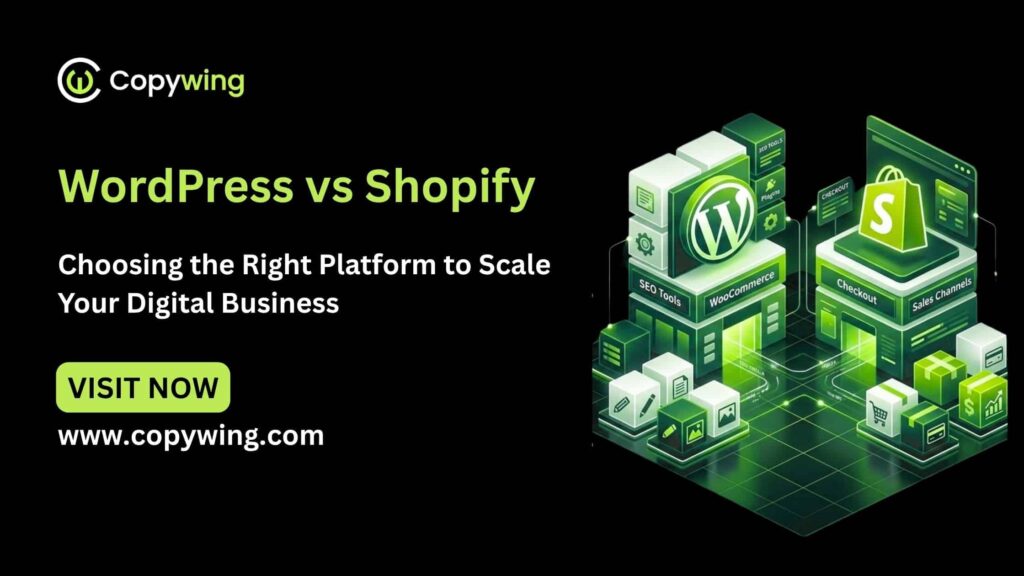
Deciding between wordpress vs shopify is the first major hurdle for any entrepreneur looking to move from a physical shop to a digital storefront. It is the digital equivalent of choosing between building your own custom house from the ground up or moving into a high-end, fully managed apartment complex. Both have their perks, but the right choice depends entirely on your technical comfort level and how much control you want over the foundation of your site.
In our experience, the best platform is the one that stays out of your way and lets you focus on growth. At Copywing, we’ve worked with countless business owners who feel paralyzed by this choice. We have seen boutique owners spend months trying to tweak a custom plugin when they could have been selling products, and conversely, we have seen growing brands feel “locked in” to a platform that didn’t allow for the specific custom features they needed. Finding the right balance between wordpress vs shopify is essential to ensure your infrastructure supports your long-term vision without becoming a technical burden.
Why Small Businesses Struggle with Digital Visibility
The transition from a physical storefront to a digital one is rarely as seamless as people expect. A local boutique owner might have incredible foot traffic, but their online store can easily become a ghost town. This happens because search engines do not rank “good intentions.” They rank technical precision and high-quality content. According to Google Search Central, having a clear site hierarchy and helping search engines find your content are foundational steps for any new website.
The problem often starts with a lack of a cohesive plan. Most small business owners wear too many hats and try to build the site themselves using a basic template, or they hire a freelancer who disappears halfway through the project. This leads to broken links and slow loading times. If a customer in Dubai tries to open your menu on their phone and it takes several seconds to load, they are gone. Visibility is earned through consistency, and if your foundation is shaky, Moz’s research suggests that poor user experience will eventually tank your rankings.
Need a custom strategy?
Our team is standing by to help guide your business toward sustainable growth and long-term digital success.
The Technical Deep Dive: Setting Up for Success in the UAE
For businesses in the UAE, the digital landscape is highly competitive. Whether you are selling luxury goods in Dubai or offering specialized services in Abu Dhabi, your website needs to do more than just look pretty. It needs to function like a well-oiled machine. This is where the choice between a self-hosted solution and a managed platform becomes critical. When you look at the infrastructure of a site, you are looking at the “invisible” work that keeps a business alive.
Technical Foundation and Site Speed
A self-hosted site gives you total ownership of your data and code. You can optimize every single line of CSS to ensure your site is lightning fast. However, this requires a “hands-on” approach to security and updates. On the other hand, managed platforms handle the hosting and security for you, which is why many UAE startups prefer them to get to market quickly. At Copywing, we recommend checking your server locations to ensure they are close to your primary audience in the Middle East to reduce latency.
Speed is not just a luxury; it is a requirement. We’ve seen businesses struggle with heavy images and unoptimized scripts that bloat the site. When a user in the UAE accesses your site via a 5G connection, they expect instant results. If your platform is bogged down by too many third-party apps or poorly coded themes, your bounce rate will soar.
On-Page Strategy and Content Relevance
On-page work involves more than just hitting a target word count. It is about “entity SEO,” which means helping search engines understand the context of your business. For a UAE-based company, this means using localized language, incorporating regional landmarks in your metadata where appropriate, and ensuring your currency and contact details are clearly formatted for the local market.
We’ve seen businesses struggle with generic content that doesn’t resonate with the local culture. Your blog posts and product descriptions should reflect the lifestyle of your target audience. If you are selling high-end furniture in Dubai, your content should speak to luxury, durability, and the specific aesthetic preferences of the region.
Off-Page Authority and Digital Reputation
Building authority is about more than just getting links. It is about building a reputation. We have seen businesses in the UAE flourish by engaging with local industry news sites and regional influencers. This creates a digital footprint that tells search engines you are a trusted authority in your specific geographic area.
Think of off-page work as digital word-of-mouth. When other reputable sites in the Middle East link back to your store, it acts as a vote of confidence. This is especially important for new businesses trying to break into a saturated market.
Pricing and ROI: A Transparent Look at the US Market
Navigating the costs of digital growth can feel like a guessing game. In the US market, a professional setup for a mid-sized business typically ranges from $2,500 to $10,000 for the initial build, depending on complexity. Ongoing maintenance and strategy usually fall between $1,500 and $5,000 per month.
The return on investment (ROI) isn’t always immediate. We tell our clients to look at the “six-month mark.” By then, the technical fixes and content pillars you’ve invested in should start driving organic traffic that would otherwise cost thousands in paid ads. It is about building an asset rather than just paying for temporary space. For example, a local contractor in Texas might spend $2,000 on a high-quality pillar page, but that page could generate leads worth $20,000 over the next year.
Common Mistakes: What NOT to Do
One of the biggest mistakes we see is the pursuit of “cheap” shortcuts. Buying a pack of 5,000 backlinks for a hundred dollars is the fastest way to get your site penalized. These links are often from “link farms” that have no relevance to your business and send a signal to Google that your site is untrustworthy. In fact, Google’s spam policies explicitly warn against link schemes that attempt to manipulate search rankings through paid or automated placements.
Another error is ignoring mobile optimization. In today’s market, over 60 percent of searches happen on mobile devices. If your site looks great on a desktop but is impossible to navigate on a smartphone, you are effectively turning away more than half of your potential customers. Copywing focuses on a “mobile-first” approach to ensure no leads are left behind. We’ve seen businesses struggle because they used a template that wasn’t truly responsive, leading to a frustrating experience for the end user, which is why following Google’s mobile-friendly guidelines is no longer optional for modern brands.
Strategic Thinking for UAE Businesses
When targeting the UAE market, you have to consider the multilingual nature of the audience. Offering content in both English and Arabic can significantly increase your reach. Furthermore, pricing models should be transparent and include local payment gateways that residents trust.
Our services include full technical audits, content creation, and localized strategy development. We provide tiered pricing based on the scale of your business, ensuring that whether you are a small startup or a large enterprise, you have a path to visibility.
Conclusion
Choosing the right path for your digital journey requires a balance of technical knowledge and clear business goals. Whether you prefer the total control of a custom build or the streamlined efficiency of a managed platform, the goal is always to provide value to your users. If you are looking to expand your reach or need specialized help with your store, it is often best to consult with Shopify experts UK to ensure your international strategy is airtight.
Need a custom strategy?
Our experts are ready to help guide you through the process. Let’s build something that lasts.
FAQ
Which platform is better for a beginner?
Shopify is generally better for beginners because it handles hosting and security, allowing you to focus purely on selling.
Do I need to know how to code?
You do not need to code for basic setups, but knowing some HTML helps for advanced customizations on any platform.
How long does it take to see results?
Most businesses see significant changes in organic traffic and search rankings within four to six months of consistent effort.
Can I switch platforms later?
Yes, you can migrate your data between platforms, though it requires careful planning to maintain your current search engine rankings.
Is SEO a one-time thing?
No, it is an ongoing process because search engine algorithms and competitor strategies are constantly changing and evolving.