
The global online food delivery market is projected to surpass $505 billion by 2030, with overall industry revenue touching $1.39 trillion in 2026. This exponential growth—driven by shifting consumer habits, dual-income households, and urbanization—means that food delivery is no longer a peripheral service; it is the core digital infrastructure of the modern restaurant industry.
For enterprise investors, restaurant chains, and tech startups, developing a proprietary food delivery ecosystem presents an opportunity to capture first-party data, bypass the 15–30% aggregator commission fees, and build scalable logistics networks. However, building a successful platform requires engineering a live, multi-sided logistical command center that synchronizes four distinct user bases simultaneously.
This comprehensive technical and business guide breaks down the architecture, engineering lifecycles, unit economics, and security paradigms required to build an enterprise-grade food delivery platform in 2026.
The Economics and Strategic Architecture of Modern Food Delivery
Before writing a single line of backend logic, developers and product owners must define the exact business model and operational scope. The architecture of a food delivery app changes fundamentally depending on who is cooking the food, who is delivering it, and how the platform monetizes the transaction.
The Multi-Vendor Aggregator Marketplace
This is the most complex software model, popularized by giants like UberEats, DoorDash, and Zomato. The platform acts as a digital intermediary connecting independent consumers with hundreds of independent restaurants and a fleet of freelance gig-economy delivery drivers. The central engineering challenge here is balancing supply and demand algorithms in real-time. If there are too many active orders in a specific geographic radius but too few active drivers, the system must autonomously trigger surge pricing to suppress consumer demand while simultaneously sending push notifications with financial incentives to pull offline drivers into the surge zone.
The Single-Brand Dedicated Application
Built exclusively for established restaurant chains or ambitious independent brands, this model bypasses the multi-vendor complexity. The software focuses entirely on direct customer retention, visual menu presentation, and loyalty loop mechanics. By removing the third-party aggregator, the brand retains 100% of its margin and, crucially, 100% of its customer data. This data powers predictive inventory management and highly targeted remarketing campaigns.
Q-Commerce and Grocery Delivery
The fastest-growing segment in 2026 is quick-commerce (Q-commerce), which promises delivery of groceries, pharmacy items, and daily essentials in 15 to 30 minutes. Developing for Q-commerce requires integrating the app not just with a restaurant POS, but with a real-time warehouse inventory management system. If a user adds a specific brand of milk to their cart, the system must verify its physical presence on the dark-store shelf in milliseconds to prevent out-of-stock cancellations.
The Cloud Kitchen (Dark Kitchen) Ecosystem
Cloud kitchens operate without physical dine-in spaces, functioning exclusively as fulfillment centers for online orders. Technologically, these platforms require advanced batch-routing logistics. A single physical kitchen facility might operate five different “virtual brands” on the app (e.g., a burger brand, a vegan bowl brand, and a dessert brand). The backend must be sophisticated enough to recognize that an order for a burger and an order for a vegan bowl—placed by two different customers living in the same neighborhood—are being prepared in the same physical building. The system must then batch these orders together and dispatch a single driver to pick up both, maximizing unit economics and driver earnings.
Platform Modules: The Four-Pillar Application Ecosystem
A functional food delivery platform is not one app; it is a synchronized ecosystem of four distinct software panels, each engineered for a specific user psychology and operational environment.
The Customer-Facing Application
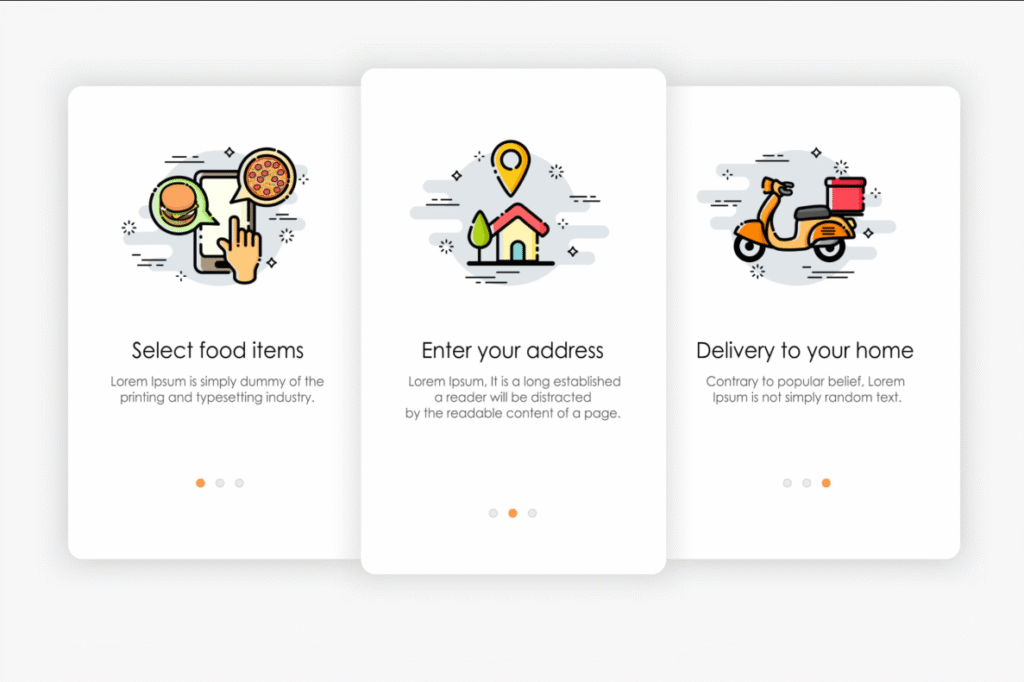
The customer interface must prioritize visual discovery and a frictionless, one-tap checkout process.. Source: aekikuis / Getty Images
The customer app is the primary revenue engine. Its design must ruthlessly eliminate friction from the discovery-to-checkout pipeline.
-
AI-Driven Discovery: Modern platforms utilize machine learning to curate the home feed. If a user consistently orders vegan food on weekday afternoons, the app’s recommendation engine should dynamically reorder the restaurant listings to prioritize nearby vegan options during those specific hours.
-
Dynamic Cart and Secure Checkout: The cart must calculate variable parameters in real-time, including localized taxes, dynamic delivery fees based on distance and weather, and applied promo codes. The checkout gateway must support global standards (Stripe, Braintree, Apple Pay) alongside localized payment methods (UPI, digital wallets) with strict PCI-DSS compliance.
-
WebSocket Tracking: Once the payment clears, the app opens a WebSocket connection to stream the assigned driver’s GPS coordinates directly to the user’s screen map, updating every few seconds without requiring manual page refreshes.
The Restaurant / Vendor Command Panel
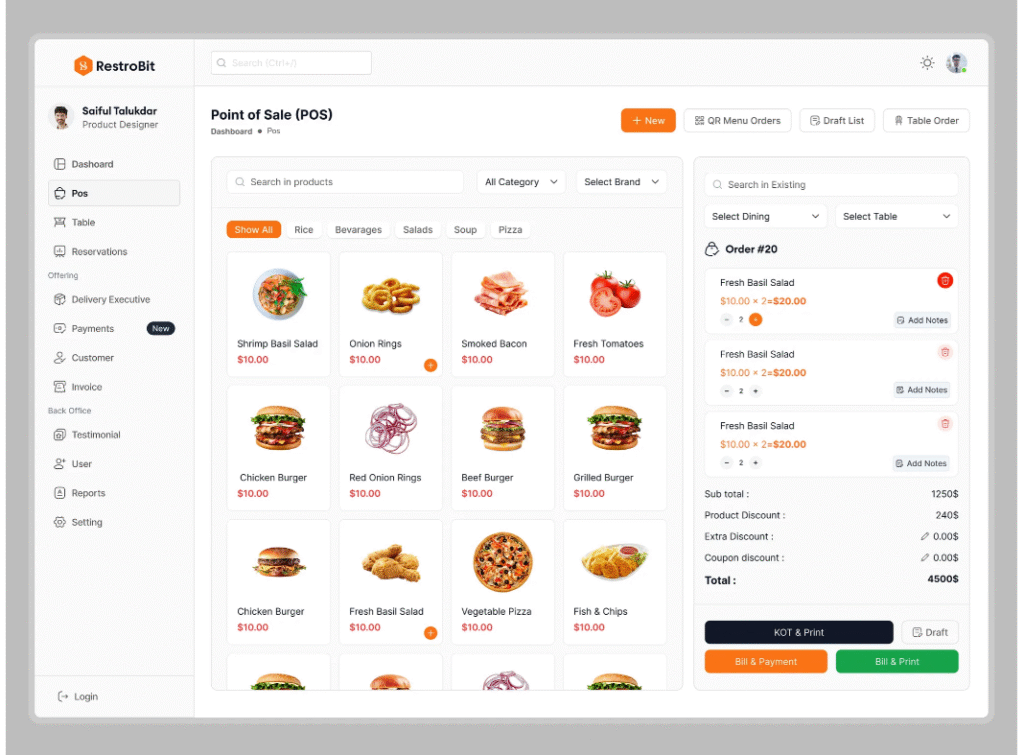
Vendor panels must allow rapid menu toggling and instant order acceptance to prevent operational bottlenecks.. Source: Dribbble
Typically deployed on a tablet or web browser, this panel operates in high-stress, high-heat, and noisy kitchen environments. The UI must rely on large typography, high-contrast colors, and loud auditory alerts.
- Live Order Ingestion: Kitchen staff must be able to accept, delay, or reject incoming orders with a single tap. If the kitchen is overwhelmed, the system should allow managers to toggle a “Busy Mode” that temporarily inflates estimated preparation times shown to end-users.
- Dynamic Inventory Toggles: If a kitchen runs out of avocados, a staff member must be able to toggle the ingredient off in the vendor panel. This action must instantaneously push an update via the API to remove avocado-based items from the customer-facing app, preventing orders that cannot be fulfilled.
- Financial Reconciliation: Dashboards providing daily breakdowns of Gross Merchandise Value (GMV), net payouts after platform commissions, and fast-moving inventory analytics.
The Delivery Partner Application
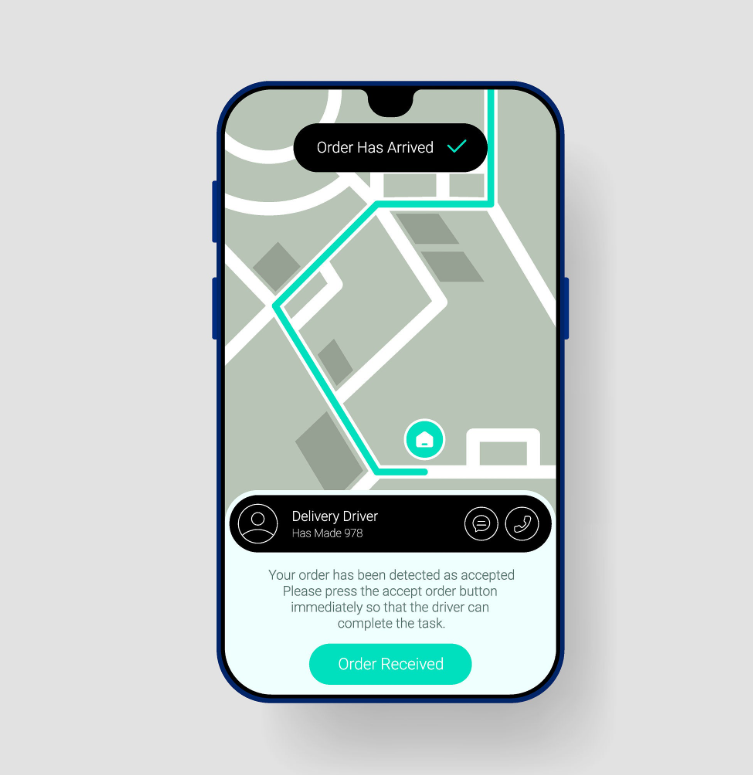
The gig-economy driver app is fundamentally a navigation and logistics tool. It must be highly optimized to minimize battery consumption and background data usage.
- Algorithmic Dispatch and Bidding: Drivers receive push notifications detailing the restaurant location, drop-off point, and estimated payout. The app must allow drivers to accept or reject the gig within a tight time window (often 15 to 30 seconds) before the algorithm routes the request to the next nearest driver.
- Turn-by-Turn Telematics: Deep integration with Mapbox or Google Maps APIs provides live traffic routing. Advanced platforms also track driver telematics—monitoring average speeds and sudden braking—to ensure safety compliance and optimize future route estimates.
- Proof of Delivery Protocol: To combat fraud, the app must support digital hand-offs, requiring the driver to input an OTP provided by the customer or upload a geo-tagged photograph of the delivered package before the system releases payment to the driver’s wallet.
The Super-Admin Command Center
This web-based dashboard is strictly for the platform operators who monitor the health of the entire multi-sided market.
-
God-View Map Analytics: Real-time visualization of all active drivers, pending orders, and system bottlenecks across an entire city.
-
Dynamic Commission Engine: Tools to configure variable commission rates per vendor (e.g., charging a local cafe 15% but a major fast-food chain only 10% due to volume).
-
Customer Support CRM: A ticketing system allowing support agents to intercept active orders, issue instant wallet credits for spilled food, or manually re-dispatch drivers in the event of a vehicle breakdown.
3. Engineering the Tech Stack: From Scalability to Security
A food delivery platform cannot rely on standard monolithic web architecture. Because thousands of GPS coordinates, payment authorizations, and push notifications fire simultaneously, the system must be built on scalable, decoupled microservices.
Frontend Engineering: Cross-Platform vs. Native
For the mobile interfaces (Customer and Driver apps), engineering teams predominantly rely on cross-platform frameworks like Flutter or React Native. These frameworks allow developers to write a single codebase and deploy it simultaneously to both iOS and Android. This approach effectively halves the initial frontend development timeline and budget compared to writing separate Swift (iOS) and Kotlin (Android) codebases. However, for enterprise-scale platforms processing millions of daily active users, native development is still occasionally preferred to extract maximum hardware performance for complex map rendering.
Backend Architecture: The Asynchronous Engine
The backend is the brain of the operation. It must handle thousands of concurrent, asynchronous requests—such as pinging a driver’s location every three seconds while simultaneously processing a credit card transaction for a different user.
-
Logic Layer: Node.js is the industry standard for real-time delivery apps due to its non-blocking, event-driven architecture, making it exceptional at handling massive volumes of simultaneous WebSocket connections. Python (Django/FastAPI) or Go are also frequently deployed for their robust data processing capabilities, particularly when algorithmic route optimization is required.
-
Database Strategy: Food delivery requires a hybrid database approach. A relational database like PostgreSQL is mandatory for storing strict, ACID-compliant financial data (user wallets, payouts, transaction histories). Conversely, a NoSQL database like MongoDB is ideal for storing highly flexible, unstructured data, such as rapidly changing restaurant menus with complex customization modifiers (e.g., “extra cheese,” “no onions”).
-
In-Memory Caching: To prevent the primary databases from crashing under the weight of thousands of users searching for nearby restaurants, systems rely on Redis. Redis caches frequently accessed, read-heavy data (like a restaurant’s static menu) in RAM, serving it to the user in milliseconds without querying the main database.
Cloud Infrastructure and Auto-Scaling
Food delivery demand is notoriously spiky. A platform might experience minimal traffic at 3:00 PM, followed by a massive surge of concurrent users at 6:30 PM.
Hosting the infrastructure on AWS (Amazon Web Services), Google Cloud Platform (GCP), or Microsoft Azure is critical. Using containerization tools like Docker and orchestration systems like Kubernetes, the platform can be configured to automatically spin up additional server instances the moment CPU usage spikes above 70%, and automatically spin them down when the dinner rush ends. This ensures the app never crashes during peak hours while keeping cloud hosting bills optimized during off-peak times.
Third-Party API Integrations
Building proprietary mapping or payment processing from scratch is a massive waste of capital. Modern apps integrate specialized APIs:
-
Geolocation & Routing: Google Maps Platform or Mapbox (for calculating ETAs, drawing map routes, and geocoding addresses into latitude/longitude coordinates).
-
Payment Gateways: Stripe, PayPal, or localized processors (Razorpay for India, Paystack for Africa) to handle secure tokenization and payouts.
-
Communication: Twilio (for SMS OTP verifications) and SendGrid (for email receipts).
-
Search: Algolia or ElasticSearch (to instantly query thousands of dishes based on user typos or dietary filters).
Security and Compliance Mandates
Security must be baked into the CI/CD pipeline from day one. Payment data must never touch the platform’s proprietary servers; it must be tokenized directly via the payment gateway to maintain PCI-DSS compliance. User data privacy must adhere strictly to regional laws (GDPR in Europe, CCPA in California, DPDP in India). Furthermore, all APIs must be secured using JSON Web Tokens (JWT) to prevent malicious actors from intercepting driver location data or spoofing order requests, while rate-limiting protocols protect the servers from automated DDoS attacks.
4. Financial Modeling: Development Costs, Timelines, and Monetization
Developing a production-ready ecosystem is a significant capital expenditure. Unlike a simple informational website, building four interconnected, real-time applications requires a specialized engineering squad consisting of UI/UX designers, mobile developers, backend architects, DevOps engineers, and QA testers.
Cost Breakdown by Platform Complexity
| Platform Scope | Included Applications | Estimated Timeline | Indicative Cost Range (USD) |
| Basic MVP | Customer App, Simple Admin Panel | 10 – 14 weeks | $30,000 – $60,000 |
| Mid-Level Dedicated App | Customer, Vendor Dashboard, Courier App | 4 – 6 months | $70,000 – $120,000 |
| Full Multi-Vendor Aggregator | All 4 Panels, GPS Tracking, Payment Splits | 6 – 9 months | $120,000 – $200,000 |
| Enterprise / Q-Commerce | AI Routing, Multi-City, Warehouse Inventory | 9 – 14+ months | $250,000 – $400,000+ |
Hidden Costs: API Usage and Maintenance
A critical oversight for many startups is failing to budget for variable operating costs. Every time a user opens the map to track their driver, the platform pays a fraction of a cent to Google Maps. At scale, this can result in mapping API bills exceeding $5,000 per month. Additionally, mobile applications require continuous post-launch maintenance to patch security vulnerabilities and update code libraries when Apple or Google release new OS versions. Industry standards dictate budgeting 15% to 25% of the initial development cost annually for ongoing server maintenance, API fees, and technical support.
Structuring the Monetization Strategy
To achieve profitability, platform operators must diversify their revenue streams beyond a single fee structure.
A sustainable model layers multiple monetization channels:
-
Tiered Vendor Commissions: Charging restaurants 15% to 30% per order based on whether they use platform drivers or their own delivery staff.
-
Consumer Delivery Fees: A base fee plus a dynamic per-mile distance charge.
-
Surge Pricing (Dynamic Multipliers): Temporarily increasing delivery fees by 1.5x to 2x during heavy rain, public holidays, or extreme traffic to offset the cost of incentivizing drivers.
-
Premium Restaurant Placement: Allowing vendors to pay a flat fee or CPC (Cost-Per-Click) rate to appear in the coveted “Featured” carousel at the top of the customer app’s home screen.
-
Subscription Memberships: Following models like DashPass or Uber One, platforms can charge users a recurring monthly fee (e.g., $9.99/month) in exchange for zero delivery fees on orders over a certain threshold. This drastically increases user retention and lifetime value (LTV), turning occasional users into habitual, high-frequency customers.
-
B2B Corporate Catering: Building specialized features for corporate clients to place bulk, scheduled orders for offices, unlocking massive average order values (AOVs) compared to individual consumer dinners.
Partner with Us: Enterprise Food Delivery App Development Services
Developing a robust food delivery platform requires more than basic mobile app development—it requires engineering a live, multi-sided logistical command center. As a premier Food Delivery App Development Company, we specialize in transforming ambitious business concepts into highly scalable, fully integrated digital ecosystems.
We do not rely on rigid white-label templates. We engineer custom architectures from the ground up, ensuring your platform is secure, lightning-fast, and capable of handling massive peak-hour order surges without a single dropped transaction.
Our End-to-End Development Suite
We build, deploy, and maintain all four critical pillars of the delivery ecosystem:
-
Custom Customer Applications (iOS & Android): We design frictionless, visually stunning mobile apps optimized for high conversion rates. From AI-driven meal recommendations to one-tap checkouts and real-time WebSocket GPS tracking, we build interfaces that keep users coming back.
-
Intelligent Vendor / Restaurant Dashboards: We equip your partner restaurants with high-visibility web and tablet panels. Our systems feature live POS integration, dynamic inventory toggles, and automated financial reconciliation to streamline kitchen operations.
-
Algorithmic Delivery Driver Apps: We build battery-optimized courier applications featuring intelligent route batching, turn-by-turn telematics (via Google Maps/Mapbox), and secure digital proof-of-delivery protocols.
-
Super-Admin Command Centers: Take total control of your marketplace. We develop custom administrative dashboards that provide a “God-view” of all active drivers, dynamic commission engines, and advanced analytics to monitor Gross Merchandise Value (GMV) and platform health.
Why Choose Us as Your Technology Partner?
Choosing the right development agency dictates the long-term unit economics of your business. Here is why industry leaders trust us with their digital transformation:
-
Microservices & Cloud-Native Architecture: We build on AWS and Google Cloud using decoupled microservices. This ensures your app automatically scales up server capacity during Friday night dinner rushes and scales down during off-peak hours, optimizing your cloud hosting costs.
-
Next-Gen AI & Logistics Integration: We implement intelligent automation, including predictive surge pricing models, AI-based demand forecasting, and smart route optimization that can reduce your average delivery times by up to 25%.
-
Enterprise-Grade Security & Compliance: We bake security into the CI/CD pipeline. Our platforms are delivered with full PCI-DSS compliance for payment tokenization, role-based access controls (RBAC), and strict adherence to global data privacy laws (GDPR, CCPA).
-
100% IP Ownership & Transparency: You own your source code, your data, and your platform. We operate with complete transparency through Agile development sprints, ensuring you have visibility into every line of code written.
-
Post-Launch SLA & Scaling Support: Our partnership doesn’t end at launch. We provide dedicated L2 and L3 technical support, proactive server monitoring, and continuous feature updates to ensure your platform dominates the market for years to come.
Final Words: It’s Time to Own Your Delivery Logistics
The food delivery industry in 2026 is unforgiving to platforms with poor user experiences or laggy logistics. The success of your business depends entirely on how seamlessly your software synchronizes hungry consumers, busy kitchens, and gig-economy drivers in real-time.
By investing in a custom, structurally sound platform, you reclaim your profit margins, own your first-party customer data, and build a digital asset with immense long-term valuation.
Don’t build a mobile app. Build a logistical empire.
Are you ready to disrupt the market? Our team of UI/UX designers, backend architects, and mobile engineers are ready to bring your vision to life.
Schedule Your Free Architecture Consultation and Project Estimation Today. Contact us now!!!