If you have ever stared at a burning hole in your marketing budget and asked yourself why ads fail, you are certainly not the first person to feel that frustration. Most campaigns don’t crash because of a lack of effort; they stumble because the bridge between the product and the person isn’t built on solid ground. In our experience, success isn’t about how much you spend, but how well you understand the nuances of the platform you’re using. According to recent industry benchmarks on advertising conversion rates, even top-tier brands face high failure rates when they ignore the basics of user psychology. When exploring ppc for small businesses, it becomes clear that many brands overlook these fundamentals.
The Foundation of a Flop
It’s easy to blame the algorithm when things go south. However, we’ve seen businesses struggle with the foundational elements of their offer long before the first dollar is even spent. If your product doesn’t solve a clear problem, no amount of clever copywriting or high-production video will save it.
The digital landscape is crowded. To stand out, you need more than just “presence”—you need precision. This precision starts with your targeting. Many advertisers cast a net so wide they end up catching nothing but “window shoppers” who have no intention of buying. To get a better grasp of the technical landscape, many professionals look to IAB’s digital standards to ensure their delivery is actually meeting modern requirements.
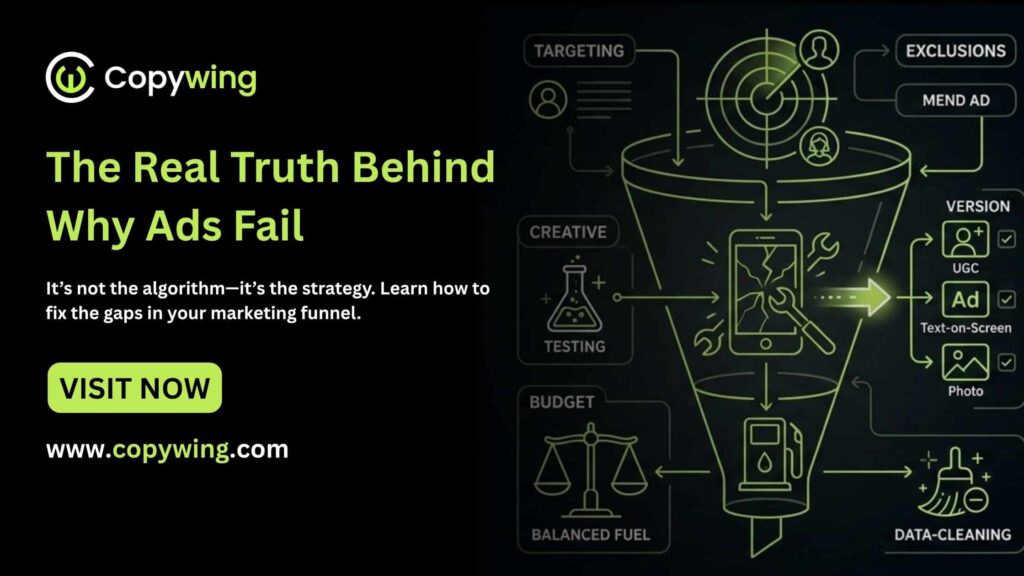
It is a common misconception that why ads fail is always tied to the creative elements. While a bad image hurts, a misplaced audience hurts more. At Copywing, we often see that the most expensive mistakes happen when an advertiser tries to speak to everyone at once.
Targeting Mistakes: Talking to the Wrong Room
Imagine trying to sell a high-end steak dinner to a room full of vegetarians. You could have the best chef in the world, but your sales will stay at zero. This is exactly what happens when your digital targeting is off.
The “Too Broad” Trap
The most frequent error we encounter is the desire to reach “everyone.” Advertisers fear that being specific means missing out on potential customers. In reality, being specific is the only way to convert. If you’re selling ergonomic office chairs, targeting “people who work” is too broad. Targeting “remote software engineers with back pain” is a strategy.
Ignoring Negative Keywords and Exclusions
We often find that what you don’t target is just as important as what you do. If you sell luxury watches, you should be excluding terms like “cheap,” “free,” or “discount.” Failing to prune your audience leads to “junk clicks” that deplete your daily budget before your actual customers even wake up.
Relying Too Heavily on Lookalikes
Lookalike audiences are powerful, but they are only as good as the source data. If your initial customer list is small or contains low-value buyers, the platform will simply find you more low-value buyers. We always recommend cleaning your data before letting an AI take the wheel.
Creative Mistakes: The Art of Being Ignored
Once you have the right people in the room, you have to say something that matters. Most people scroll past ads because the content looks like… well, an ad.
Lack of a “Pattern Interrupt”
People use social media to be entertained or informed, not to be sold to. If your creative looks like a polished corporate brochure, the human brain is trained to skip it. In our experience, some of the highest-performing ads are those that look native to the platform—user-generated content (UGC), simple text-on-screen videos, or “behind-the-scenes” photos.
The “Me, Me, Me” Syndrome
Your customers don’t care about your company’s founding anniversary. They care about their own problems. We’ve seen businesses struggle with engagement because their copy focuses on features rather than benefits.
- Feature: This vacuum has a 500-watt motor.
- Benefit: Clean your entire house in half the time without breaking a sweat.
Weak Call to Action (CTA)
If you don’t tell people exactly what to do next, they will do nothing. “Learn More” is fine, but “Get Your Free Quote” or “Claim Your 20% Discount” is better. At Copywing, we advocate for CTAs that are specific and low-friction.
Struggling to get results?
Stop wasting your budget on campaigns that don’t convert. Let our experts audit your strategy and find the gaps today.
Budget Mistakes: The Financial Friction
Money is the fuel for your campaign, but if the engine is broken, adding more fuel just makes the fire bigger.
Starting Too Big
It’s tempting to dump a huge budget into a new campaign to “see what happens.” This is almost always a mistake. We suggest starting with a small “testing budget” to identify which combinations of creative and targeting are actually working. Once you find a winner, then you scale.
Not Allowing for Learning Phases
Most modern ad platforms have a “learning phase.” During this time, the platform’s AI is figuring out who is most likely to click or buy. If you change your budget or your creative every 24 hours, you reset that learning. Patience is a budget’s best friend.
Ignoring the “Landing Page” Experience
You can have a perfect ad, but if it leads to a slow, confusing, or ugly website, you’ve wasted your money. The “ad” only gets the click; the “page” gets the sale. If there is a disconnect between the promise of the ad and the reality of the website, your bounce rate will skyrocket.
Brand Consistency and Trust (E-E-A-T)
Building trust is a long game. Users are savvy; they can smell a “get rich quick” scheme or a low-quality dropshipping store from a mile away. To succeed, your brand must demonstrate Experience, Expertise, Authoritativeness, and Trustworthiness.
At Copywing, we believe that every ad is a brick in your brand’s house. If the bricks are shaky, the house won’t stand. Show your face, use real testimonials, and provide value before you ask for a credit card number. This builds the rapport necessary to turn a stranger into a loyal customer.
Summary of Success
To avoid the pitfalls of modern digital marketing, you must move beyond the surface level. Success is found at the intersection of tight targeting, relatable creative, and a disciplined budget. Remember that every “failed” ad is actually a data point that tells you what not to do next time.
By refining your audience, focusing on the customer’s pain points, and ensuring your website is ready for the traffic, you significantly increase your chances of a high return on investment. Avoid the common traps of being too broad or too “salesy,” and focus on building a genuine connection with your market. This holistic approach is the ultimate marketing campaign solution for any brand looking to grow.
Need a custom strategy?
Get a tailored roadmap designed to scale your business and maximize your ROI with our senior strategists.
Frequently Asked Questions
How long should I wait before changing a failing ad?
Give the platform at least 7 days to exit the learning phase. Constant tweaking prevents the algorithm from optimizing your results effectively.
Why is my click-through rate high but my sales low?
This usually indicates a disconnect between your ad and your landing page. Your ad is interesting, but your website isn’t closing the deal.
What is the most important part of an ad?
The hook or the first three seconds of a video. If you don’t stop the scroll, the rest of your content doesn’t matter.
How much should I spend on my first ad campaign?
Start with an amount you are comfortable losing. Use this to test different creatives and audiences before committing a larger budget.
Can I run ads without a professional designer?
Yes. Authenticity often beats high-production value. Simple photos and direct-to-camera videos frequently outperform polished, expensive commercials.