A minimum viable product (MVP) is the leanest version of your product that still delivers clear value, validates real demand with real users, and produces early traction strong enough to convince investors in 2026’s highly selective startup environment. With global funding becoming more competitive and over 85% of early-stage investors now requiring functional MVPs and usage metrics before committing capital, founders can no longer rely on ideas or pitch decks alone.
Recent startup research shows that companies that launch an MVP within the first 90 days of development are 3× more likely to secure pre-seed funding, largely because investors trust real data, activation rates, retention, engagement, and early monetization over assumptions. This shift makes disciplined MVP development essential.
To build an MVP that truly raises funding, founders must combine sharp market positioning with evidence-based iteration, clear traction signals, and a funding strategy aligned with how investors now evaluate risk. In 2026, an MVP isn’t just a product step, it’s your validation engine, learning system, and strongest fundraising asset.
What is a Minimum Viable Product?
A minimum viable product is the most basic version of a product that solves a real problem for a specific audience while being cheap and fast enough to build so you can test your assumptions in the real market. Unlike a prototype or mockup, an MVP is usable by real customers and generates data on engagement, retention, and willingness to pay.
In 2026, a minimum viable product for startups often includes a simple but functional core workflow (for example, sign up → perform the main task → get a clear outcome) plus minimal design polish and analytics to measure performance. Investors increasingly expect an MVP to show early indicators of product‑market fit, such as active users, repeat usage, or early revenue.
Why build an MVP before full product development?
Launching a full product without validation is risky, especially when over 80–90% of startups fail because they build something the market does not need. MVP development significantly reduces this risk by validating your problem, audience, and solution before you pour money into full-scale product development.
Key reasons to build a minimum viable product first:
- Validate market demand and avoid building features nobody uses.
- Shorten time to market and begin learning from real customers earlier.
- Use real usage metrics to refine positioning and messaging before scaling.
- Create early proof points (traction, LTV/CAC assumptions, retention) that investors trust more than pitch-deck promises.
For founders, the real value of MVP development is not just cost-saving but learning—understanding what users actually value, which is exactly what funding decisions increasingly hinge on.
MVP vs prototype vs full product
Understanding the differences helps you decide what to ship first and what to show investors.
| Aspect | Prototype | Minimum viable product (MVP) | Full product |
| Purpose | Visual or functional demo for internal validation | Validate core value with real users and early adopters | Scale to wider market and optimize revenue |
| Users | Internal team, small test group | Real customers in target market | Broad user base |
| Features | Incomplete, often non-functional flows | Only essential features to deliver the core value | Full feature set, integrations, automation |
| Data collected | Qualitative feedback and usability notes | Quantitative metrics (activation, retention, revenue) | Advanced metrics, cohorts, growth funnels |
| Cost & time | Lowest | Moderate | Highest |
Core Benefits of MVP Development for Startups in 2026
Minimum Viable Product (MVP) development has evolved far beyond a buzzword. In 2026, with funding environments tightening and investors demanding concrete proof of traction, the MVP stands as one of the most powerful strategic tools a startup can use. It provides tangible validation—proof of execution, proof of demand, and proof of learning ability.
An MVP is not just the first version of a product. It’s a real-world experiment that helps founders test assumptions, attract investors, and reduce the most critical business risks without wasting time or resources.
MVPs as a Signal of Execution for Investors
A polished pitch deck or visionary roadmap no longer guarantees investor attention. Modern investors prioritize data-backed execution over storytelling. A strong MVP delivers precisely that—evidence of real-world progress.
Why MVPs Attract Investors
A well-executed MVP gives investors confidence that:
- The team can turn ideas into working products.
- Users genuinely need the solution.
- There’s measurable market pull, not just theoretical demand.
Instead of asking investors to “believe,” founders can show through an MVP that their solution works and their target audience engages with it.
How Investors Evaluate an MVP
In 2026, investor evaluation frameworks have become data-driven and outcome-oriented. Most pre-seed and seed investors look for three key signals when reviewing an MVP:
1. Product Functionality — Does it actually work?
The MVP should reliably deliver the promised outcome, even if it’s not yet polished. Investors expect usability and stability under normal conditions to prove technical feasibility.
2. Early Product-Market Fit Signals
Investors examine early user behavior to gauge traction:
- Active users and consistent engagement
- Session frequency and average usage depth
- Retention trends and repeat visits
- Organic or word-of-mouth referrals
Even if numbers are small, upward trends matter more than vanity metrics.
3. Team Learning and Execution Velocity
Investors reward adaptability. A strong MVP demonstrates that founders can:
- Prioritize core features over noise
- Make fast, data-driven decisions
- Iterate quickly based on user feedback
In 2026’s funding landscape, “learning velocity” is a core indicator of long-term success.
MVP Development as a Strategic Risk-Reduction Tool
Most startups fail not from lack of ideas, but from prolonged execution on flawed assumptions. MVP development drastically reduces this risk—saving both capital and morale.
Turning Assumptions into Data
An MVP replaces optimistic forecasts with measurable outcomes. It provides data like:
- User interactions and repeat usage patterns
- Conversion metrics across the funnel (visit → sign-up → activation → repeat usage → payment)
- Behavioral analytics showing what users actually do
These insights help founders align their product with real customer needs, not hypothetical ones.
Validating or Invalidating Core Assumptions
An MVP tests key questions early:
- Who exactly is the target user?
- Which pain points truly matter?
- What features drive value versus clutter?
- What pricing or monetization models users accept?
Invalidating an assumption quickly is a victory—it prevents wasted investment in the wrong direction. This principle applies across SaaS, fintech, healthcare, logistics, and mobile-products, where mistakes can be expensive.
Real-World MVP Examples that Attracted Funding
Studying how historically successful companies used MVPs helps founders design their own path. These stories are reminders that innovation rarely starts with perfection—it starts with focus.
Airbnb: Proving Market Demand with Simplicity
Airbnb’s first version was a simple website offering space in the founders’ apartment during a design conference. No algorithms, no dashboards—just a few photos and prices.
Validated ideas:
- Travelers would pay for short-term stays in private homes.
- Hosts would share unused space for income.
- Online transactions for stays were trusted and convenient.
This small test proved a multi-billion-dollar opportunity.
Uber: Testing Convenience and Trust in One City
Uber’s MVP—then called UberCab—operated only in San Francisco. It allowed users to book black cars via an app and pay digitally. No surge pricing, no food delivery, just one clear feature.
Validated ideas:
- Users wanted on-demand, cashless rides.
- Drivers accepted app-mediated jobs.
- Price transparency increased trust.
These signals attracted investor confidence and paved the way for expansion.
Snapchat: Building Emotional Value Through Focus
Snapchat’s MVP, Picaboo, featured just one tool—sending disappearing photos.
Validated ideas:
- Users wanted private sharing without permanence.
- Emotional engagement could beat technical complexity.
- Simplicity can create unique user behavior patterns.
Snapchat’s growth later came from layering new features on top of a clearly validated core insight.
Common Patterns from Successful MVPs
Across Airbnb, Uber, Snapchat, and other breakout startups, four consistent MVP patterns stand out:
- Single Problem Focus: Each started with one narrow but high-value use case.
- Limited Target Audience: Launching in one market, city, or community sharpened feedback loops.
- Rapid User-Driven Iteration: Real usage dictated the roadmap.
- Clear Proof Signals: Evidence of repeat engagement mattered more than size or scale.
These shared traits illustrate that an MVP’s strength lies not in sophistication but in clarity and measurable traction.
Designing an MVP That Raises Money in 2026
In today’s investor climate, an MVP must be engineered for clarity, not completeness. Founders should design MVPs to make investor evaluation easy—showing traction, product impact, and adaptability at a glance.
Key Takeaways for Founders
- Build around one sharp problem and a measurable outcome.
- Track usage metrics that demonstrate user commitment.
- Highlight iteration speed to prove team resilience.
- Communicate data and learnings transparently to investors.
These are the MVP signals that will unlock funding opportunities in 2026 and beyond.
How investor expectations for MVPs are changing in 2026
In 2026, investors in most major markets expect more from an MVP than a few years ago due to intense competition, AI acceleration, and capital efficiency pressures. A minimum viable product that raised money in 2018 may no longer be enough without better metrics and sharper positioning.
New expectations often include:
- Clear differentiation, not just another generic mobile app development idea.
- Evidence of repeat usage (retention over at least 4–8 weeks) rather than just sign‑ups.
- Some revenue or at least clear monetization experiments, especially in SaaS.
- Thoughtful use of AI or automation if your domain can benefit from it, as AI‑driven MVP development is now common in 2026.
Founders should design MVP development around these expectations if they want to raise funding on the back of their first product version.
Steps to build an MVP that raises money
The core process for how to build an MVP that raises money in 2026 can be broken into structured steps. These steps to build an MVP apply across SaaS, marketplace, and mobile app development, though implementation details will vary.
1. Clarify the problem and market
Start by defining a single sharp problem for a specific audience instead of a broad, vague vision. This is foundational for minimum viable products for startups because everything—features, UX, metrics, and pitch—aligns with this clarity.
Key actions:
- Define one narrow target user persona (for example, “mid‑sized e‑commerce operators in the UAE struggling with last‑mile delivery visibility”).
- List the primary pain points and how they currently solve them (competitors, manual processes, hacks).
- Validate the problem via 10–30 user interviews, focusing on willingness to pay and urgency.
For funding, investors want to see that you deeply understand the market and have evidence that the problem is painful and unsolved for a specific segment.
2. Conduct market research for MVP
Market research for MVP helps you avoid building a “nice to have” solution or duplicating existing products. This phase should be lean but structured.
Actions to take:
- Analyze direct competitors (features, pricing, positioning, user reviews).
- Map indirect competitors and substitutes (spreadsheets, manual work, generic tools).
- Estimate market size (TAM/SAM/SOM) and identify niches where you can win early.
These insights guide which features your minimum viable product must include to be viable and which can wait, and they strengthen your investor narrative around market opportunity.
3. Define your value proposition and success metrics
Before designing the product, clearly define what makes your solution different and better, and how you will measure success for the MVP. This step is often skipped, but investors care deeply about differentiation and KPI clarity.
Decide:
- Core value proposition: a clear sentence describing who you serve, what problem you solve, and what outcome you deliver.
- MVP success metrics: activation rate, weekly/monthly active users, retention, conversion to paid, or time saved for users.
- Hypotheses: for example, “Remote logistics teams will log into the app at least 3 times per day if we give them real-time route insights.”
MVP development benefits are strongest when you treat it as an experiment with clear hypotheses, not just a smaller build.
4. Outline MVP features (less is more)
Now convert your problem and value proposition into a minimal feature set. The goal of MVP development is not to impress with breadth but to deliver one outstanding core workflow.
Steps:
- Map the full ideal product journey, then strip it down to the smallest set of steps that still deliver value.
- Classify features as Must‑have, Nice‑to‑have, or Later; the minimum viable product should only include Must‑have items.
- Focus on 1–2 killer features (for example, automated dispatch + live tracking) rather than a long list of shallow ones.
This is where many founders fail: they overload the minimum viable product and lose the speed and focus that make MVP development powerful.
5. Choose the right tech approach for your MVP
Your technology choices should minimize time‑to‑market while still enabling iterative growth. In 2026, options range from no‑code tools to fully custom stacks, plus AI components where useful.
Common choices:
- No‑code/low‑code builders for simple workflows and internal tools.
- Cross‑platform frameworks (like React Native or Flutter) for mobile app development to ship faster across platforms.
- Off‑the‑shelf components for auth, payments, analytics, and messaging.
- AI APIs or models for recommendations, automation, or predictions when these materially improve your offer.
Investors care more about speed of learning and scalability than about any specific stack, so prioritize what lets you iterate quickly without blocking future product development.
6. Design UX/UI around the core flow
Great MVP development does not mean ugly or confusing design; it means focused UX. At minimum, your product should make it frictionless for users to reach the “aha” moment where they feel value.
UX priorities:
- Clean, uncluttered screens with only essential elements.
- A guided onboarding that gets users through the core workflow quickly (for example, within 90 seconds of sign‑up).
- Clear CTAs and feedback states so users always know what is happening.
A polished, simple UX also helps convince investors that your team understands user‑centric design and can compete in crowded product development markets.
7. Build and launch MVP to a narrow audience
Once design and feature scope are finalized, move into building and launch the MVP to a small, focused audience rather than a broad public launch. This aligns with how to build an MVP that raises money: investors prefer deep engagement in a niche over shallow global traffic.
Best practices:
- Soft‑launch to a few dozen to a few hundred carefully selected users.
- Use a waitlist or invitation system to maintain control over demand and feedback.
- Instrument analytics from day one to track activation, retention, and feature usage.
In many cases, a “closed beta” style release is ideal for minimum viable product for startups looking to learn fast and refine before public PR.
8. Collect and analyze MVP feedback
Analyze MVP feedback continuously to drive rapid iterations. Your goal is to understand not just what users say but what they actually do in the product.
Sources of MVP feedback:
- In‑app analytics (click paths, drop‑off points, session duration).
- Customer interviews and surveys focused on “what job were you trying to get done?”
- Support tickets, chat logs, and community discussions.
Using this feedback effectively is at the heart of MVP development benefits: you refine the product based on evidence, not assumptions, which in turn creates stronger proof for investors that you can execute.
9. Iterate quickly based on data
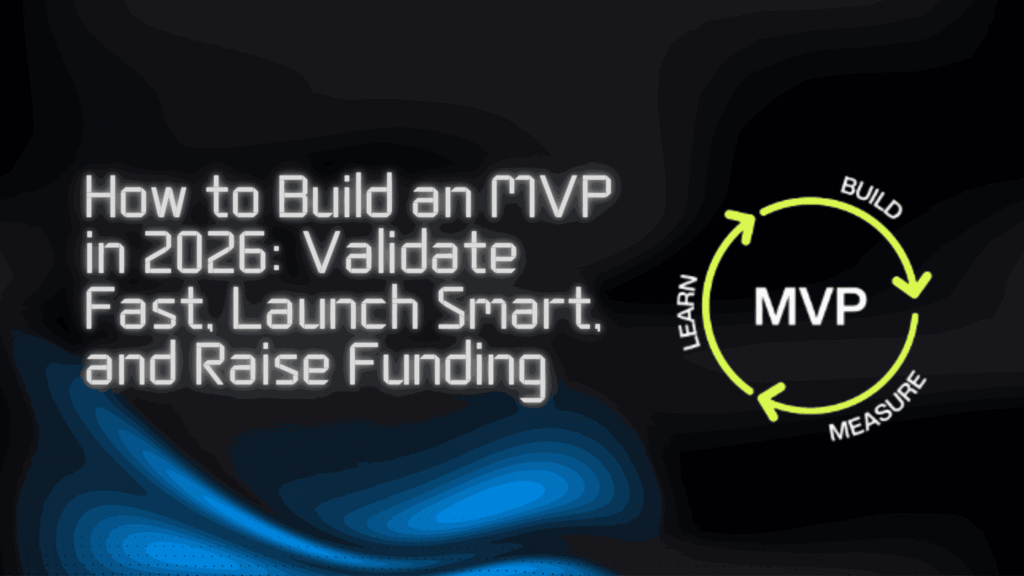
Post-launch, minimum viable product development becomes a loop: measure → learn → build → release. In 2026, speed of iteration is often a competitive advantage, especially as AI and automation shorten cycles.
Iteration strategy:
- Prioritize fixes and enhancements that directly improve your core metrics (activation, retention, conversion).
- Remove or hide unused features that confuse users and dilute focus.
- Run A/B tests on key flows like onboarding and pricing if traffic volume allows.
Investors notice when a team pushes multiple releases per month and can show graphs of metrics improving over time; this is a huge credibility booster when trying to raise funding on your MVP.
MVP development cost range in 2026
Understanding the MVP development cost range is critical for planning your runway and funding strategy. Recent industry guides show that typical MVP development costs in 2025–2026 range roughly from around 15,000 dollars at the low end to 150,000 dollars or more for complex apps, depending on scope, team type, and geography.
Breakdown examples:
| MVP Type / Scope | Description | Typical Cost Range (USD) | How to Keep Cost Low Without Losing Quality |
|---|---|---|---|
| Simple MVP | Few screens, single core flow (e.g., basic web app, simple marketplace, or form‑based SaaS) | 15,000–40,000 | Build only the core workflow, use templates and no‑/low‑code where possible, launch on a single platform. |
| Medium Complexity MVP | Custom UI, multiple user roles, basic integrations (payments, auth, analytics) | 40,000–80,000 | Limit integrations to essentials, reuse components, prioritize must‑have features, use cross‑platform frameworks. |
| Complex MVP | Advanced workflows, rich UI, real‑time features, or AI/ML components | 80,000–150,000+ | Phase the build into milestones, prototype AI features with APIs first, use modular architecture to avoid over‑engineering. |
These ranges assume a professional team (agency or experienced freelancers) and can be lower with very small teams or higher with premium US/EU agencies. The key is to use the cost levers—scope, platform choice, reusable tech, and lean teams, without compromising on a stable core workflow and a clean user experience that investors can trust.
Key MVP cost factors include:
- Number and complexity of core features and workflows.
- Platforms supported (web only vs web + iOS + Android).
- Design polish and branding requirements.
- Team structure (freelancers, in‑house, or agency) and location.
Comparatively, full product development costs can be multiples of the MVP budget, which is why MVP vs full product cost is an important talking point with investors.
How to reduce MVP development cost without hurting quality
Founders often ask how to keep the minimum viable product affordable while still credible enough for funding. Several strategies can optimize MVP development cost:
- Ruthlessly prioritize features; each additional feature adds design, development, and testing overhead.
- Use reusable components and established frameworks rather than reinventing infrastructure.
- Start with one platform (for example, web) instead of immediate full mobile app development, unless mobile is absolutely core to the value proposition.
- Work with smaller, specialized teams that focus on MVP development rather than large, generalized setups.
Discussing your lean approach to MVP development cost with investors can actually strengthen your case by showing capital efficiency.
How to find investors for MVP in 2026
Once your minimum viable product is built and you have initial traction, the next challenge is how to find investors for MVP in a noisy funding environment.
1. Map the right investor profile
Not every investor is right for every MVP. You need to identify:
- Pre‑seed/seed VCs that focus on your industry, geography, and stage.
- Angel investors with operational experience in your domain.
- Strategic investors (for example, logistics firms for a logistics MVP) that can provide distribution.
Understanding investor theses helps you align your pitch with what they care about, increasing your chances of raising funding on your MVP.
2. Use warm introductions and curated platforms
In 2026, competition for cold outreach is fierce. You improve odds by:
- Getting warm introductions from founders, advisors, and early customers.
- Using curated platforms and communities that match startups with investors.
- Attending focused industry events and demo days rather than generic conferences.
This targeted approach is far more effective than mass emailing investors about your minimum viable product.
3. Leverage crowdfunding and alternative funding
Beyond traditional angels and VCs, types of MVP funding partners include:
- Equity crowdfunding platforms that allow many small investors to back your MVP.
- Revenue-based financing for products with early recurring revenue.
- Grants, accelerators, and government innovation programs targeted at startups in sectors like health, climate, or logistics.
Diversifying funding sources can reduce dilution and give you more options to grow your MVP into a full product.
How to Pitch an MVP that Raises Money
Build a Narrative Around Learning and Traction
A strong MVP pitch is not “we only built a small product because we lacked money,” but “we executed a focused MVP to validate the riskiest assumptions efficiently.”
Your narrative should:
- Explain the problem, why it matters now, and who is affected most.
- Describe how you built the minimum viable product and what you learned.
- Show before‑and‑after outcomes for users that used your MVP.
Emphasize that MVP development benefits allowed you to de‑risk the business and that new capital will scale what is already working.
Highlight key MVP metrics and evidence
Investors look for concrete MVP metrics more than feature lists. Include:
- Number of sign‑ups and active users, broken down by weekly or monthly active users.
- Retention curves (for example, 4‑week retention) and engagement (sessions per user).
- Early revenue, conversion rates, or pilots with paying customers.
Even if numbers are modest, a clear upward trend and strong engagement can make your minimum viable product for startups very compelling.
Be honest about limitations and roadmap
No MVP is perfect. Investors know this and will test your realism. Be transparent about:
- What the MVP does not yet do and why (for example, no enterprise features yet).
- Which parts of your tech might need refactoring at scale.
- Your roadmap for evolving from MVP to full product and how the funding will be used.
This honesty increases trust and shows you understand how to build an MVP that raises money in stages rather than promising unrealistic leaps.
Common MVP mistakes that scare investors away
Even strong ideas can fail to raise funding if the MVP is poorly planned. Some common mistakes include:
- Overbuilding: creating a bloated product with many half‑baked features instead of a laser‑focused minimum viable product.
- No clear metrics: launching without analytics or KPIs, leaving you with anecdotes instead of evidence.
- Ignoring feedback: pushing ahead with your roadmap despite consistent negative MVP feedback.
- Copycat positioning: pitching “Uber for X” or “Airbnb for Y” without real differentiation beyond the analogy.
Avoiding these mistakes is as important as following the steps to build an MVP, especially when investors evaluate execution quality.
How Copywing Core can fit into your MVP journey
Many startups choose technology and product partners to accelerate MVP development and reduce execution risk. Independent product studios and agencies focused on MVP development for startups can:
- Help refine your idea into a concrete minimum viable product scope.
- Provide end‑to‑end support from market research to UX, development, and post‑launch iterations.
- Offer guidance on MVP development cost optimization and technical trade‑offs.
When selecting a partner such as Copywing Core, founders should look for:
- A track record of shipping MVPs that later raised funding.
- Experience across multiple industries and product development models.
- Transparent communication, agile processes, and a willingness to challenge assumptions to protect your runway.
A strong partner is not just a development vendor but a strategic ally in how to build an MVP that raises money efficiently and sustainably.
Checklist: how to build an MVP that raises funding in 2026
To tie everything together, here is a concise checklist you can use when planning minimum viable product development:
- Problem and audience: narrowly defined, validated with interviews and basic market research.
- Value proposition: clear, differentiated, and aligned with urgent customer pain.
- MVP scope: only essential features that enable one core workflow and measure its success.
- Tech and design: chosen for speed and scalability, with simple, user‑friendly UX.
- Launch plan: targeted early adopters, clear messaging, and instrumented analytics.
- Metrics: activation, retention, revenue, or other success indicators tracked from day one.
- Feedback loop: structured process for collecting and acting on MVP feedback rapidly.
- Funding story: coherent narrative connecting your minimum viable product benefits, traction, and the capital you seek to the next set of milestones.